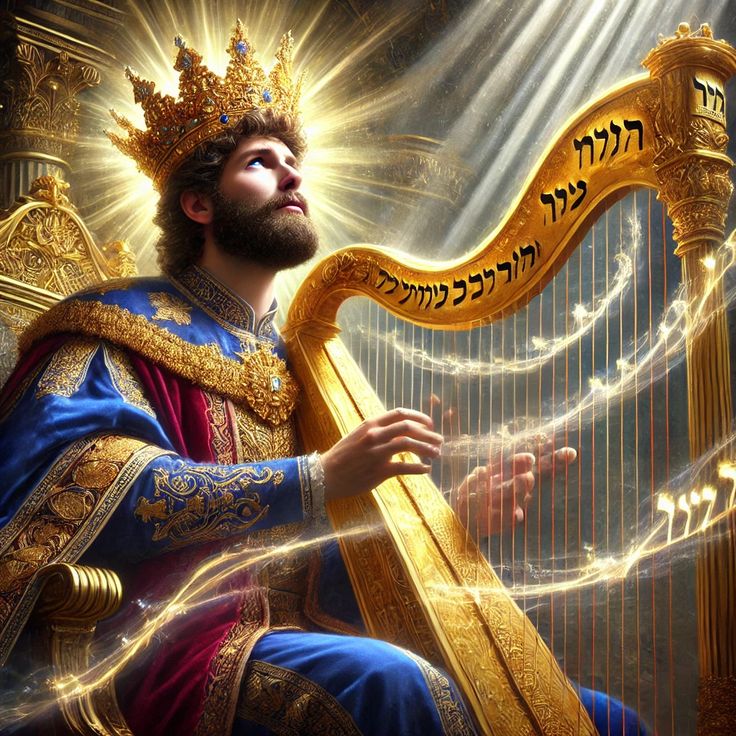
Picture: David was anointed as king to replace Saul. He was set to play the harp as therapy for Saul, but had to escape to save his life. He prophesied that Christ was God’s Messiah (anointed), he was killed, but God raised him from the dead and installed him as his Messiah at his right hand in heaven.
In the Psalms, many testified to their faith in God, and the psalmist Asaph prophesied that God would stand in the “assembly of the gods” and render judgment.
Moses told the people that they were to be children of God, so that through his instruction and training they would grow up to be “gods”. But Moses foresaw that they would rebel, so that they would lose their land and be taken away. When they were then allowed to return to their land by God’s grace, they were to be circumcised on heart.
God had Samuel anoint David as king, even so he had to flee from Saul and his army, but it was in this way that he took refuge in the Lord and asked Him to save him from the enemy and then it happened that the enemy was judged and lost in battle and that was his salvation. We see this time and again in the Old Testament and that hope is expressed in their prayers as well.
Asaph was a psalmist in David’s time and he said that God stands in the “assembly of gods” and holds judgment, and that is precisely what happened with David and he made many prophecies about the Messiah.
Psalm.82,1 A psalm of Asaph.
God stands in the assembly of El;
in the midst of the gods he renders judgment.
2 He says, “How long will you make unjust legal decisions
and show favoritism to the wicked? (Selah)
3 Defend the cause of the poor and the fatherless.
Vindicate the oppressed and suffering.
4 Rescue the poor and needy.
Deliver them from the power of the wicked.
5 They neither know nor understand.
They stumble around in the dark,
while all the foundations of the earth crumble.
6 I thought, ‘You are gods;
all of you are sons of the Most High.’
7 Yet you will die like mortals;
you will fall like all the other rulers.”
8 Rise up, O God, and execute judgment on the earth!
For you own all the nations.
Salms.95,3 Come, let us sing for joy to the Lord.
Let us shout out praises to our Protector who delivers us.
2 Let us enter his presence with thanksgiving.
Let us shout out to him in celebration.
3 For the Lord is a great God,
a great king who is superior to all gods.
.
Psalme.136,1 Give thanks to the Lord, for he is good,
for his loyal love endures.
2 Give thanks to the God of gods,
for his loyal love endures.
3 Give thanks to the Lord of lords,
for his loyal love endures.
4 To the one who performs magnificent, amazing deeds all by himself,
for his loyal love endures.
The people of Israel fell away from the Lord their God, so their land was taken and they were taken away to Babylon. But they were allowed to return to their land, as prophesied. Thus the God of Israel showed that he was the true God.
Isaiah.41,21 “Present your argument,” says the Lord.
“Produce your evidence,” says Jacob’s King.
22 “Let them produce evidence! Let them tell us what will happen!
Tell us about your earlier predictive oracles,
so we may examine them and see how they were fulfilled.
Or decree for us some future events!
23 Predict how future events will turn out,
so we might know you are gods.
Yes, do something good or something bad,
so we might be frightened and in awe.
24 Look, you are nothing, and your accomplishments are nonexistent;
the one who chooses to worship you is disgusting.
25 I have stirred up one out of the north and he advances,
one from the eastern horizon who prays in my name.
He steps on rulers as if they were clay,
like a potter treading the clay.
26 Who decreed this from the beginning, so we could know?
Who announced it ahead of time, so we could say, ‘He’s correct’?
Indeed, none of them decreed it.
Indeed, none of them announced it.
Indeed, no one heard you say anything!
27 I first decreed to Zion, ‘Look, here’s what will happen!’
I sent a herald to Jerusalem.
28 I look, but there is no one,
among them there is no one who serves as an adviser
that I might ask questions and receive answers.
29 Look, all of them are nothing,
their accomplishments are nonexistent;
their metal images lack any real substance.
For God so loved the world that he gave his only begotten Son, that whosoever believd in him should not perish, but have everlasting life. And he stood i the council of gods, and judged.
Joel prophesied that God would pour out his Spirit on all flesh, but then he also prophesied about a day of judgment.
Joel.2,27 You will be convinced that I am in the midst of Israel.
I am the Lord your God; there is no other.
My people will never again be put to shame.
An Outpouring of the Spirit
28 (3:1) “After all of this
I will pour out my Spirit on all kinds of people.
Your sons and daughters will prophesy.
Your elderly will have prophetic dreams;
your young men will see visions.
29 Even on male and female servants
I will pour out my Spirit in those days.
30 I will produce portents both in the sky and on the earth—
blood, fire, and columns of smoke.
31 The sunlight will be turned to darkness
and the moon to the color of blood,
before the day of the Lord comes—
that great and terrible day!
32 It will so happen that
everyone who calls on the name of the Lord will be delivered.
For on Mount Zion and in Jerusalem there will be those who survive,
just as the Lord has promised;
the remnant will be those whom the Lord will call.
This judgment day (the Lord’s day) was primarily that Christ died on the cross for the sin of the whole world and with his death judged the sin in the flesh.
The sin in the flesh can simply be said to be that they tried to idolize themselves with their fleshly nature. It was by eating from the tree of knowledge, the tree that gives knowledge of good and evil, so they tried to idolize themselves with their knowledge of good and evil, a moral philosophical knowledge, that is.
After the fall, Adam and Eve noticed that God was walking in the garden, so they hid from him with a bad conscience, with the attitude, that is, that the love relationship between them was something that God should have anything to do with. But God called Adam and there was a court settlement, Adam was sentenced to death, he was dust and to dust he would return. God is spirit, but Adam was dust and was not like God anyway.
But Christ died on the cross instead of us, God raised him from the dead and seated him at his right hand in heaven, to be our high priest with the Father, our savior king and king of kings. When we accept Christ by faith, we receive the salvation that God gives us in him and then we will see it as if we were crucified and died with him and in baptism buried with him, there we are also resurrected with him by the saving power of God who raised him from the dead.
But we have the same bodies, unless he has healed us for illness. visible or invisible, the same biology, the same genes, unless he has healed us for a hereditary disease. How can we then have received a new nature? It is like with the wheat grain, when it is pollinated, it gets a new nature, which is different from the rest of the plant. The pollination here is a symbol of the new nature Jesus gives us from heaven, he is the bread of life who came down from heaven to give life to the world, the Word he has spoken to us is spirit and life. God harvests the grain and takes care of it, but it is different with the chaff, these are those who have not received in faith and have not received a new nature.
Luk.3,15 While the people were filled with anticipation and they all wondered whetherperhaps John could be the Christ, 16 John answered them all, “I baptize you with water, but one more powerful than I am is coming—I am not worthy to untie the strap of his sandals. He will baptize you with the Holy Spirit and fire. 17 His winnowing fork is in his hand to clean out his threshing floor and to gather the wheat into his storehouse, but the chaff he will burn up with inextinguishable fire.”
Acknowledge Christ as our Savior and Lord, so that we protect ourselves against those who would steal our freedom.
Moses told the people that they should be children of God, but he foresaw that they would rebel and be punished for it and be taken away from their land. But by God’s grace they should return to it and then they should be circumcised. When they returned to their land, it was important for them to start building the temple, because then God would bless them. They faced opposition, but the prophet Zechariah encouraged them and said that it only happened by the Spirit of God.
Zec.4,6 6 Therefore he told me, “This is the Lord’s message to Zerubbabel: ‘Not by strength and not by power, butby my Spirit,’ says the Lord of Heaven’s Armies.
7 “What are you, you great mountain? Because of Zerubbabel you will become a level plain! And he will bring forth the temple capstone with shoutings of ‘Grace! Grace!’ because of this.”
Since then, Paul called the new covenant the circumcision of the heart in the Holy Spirit. The point is precisely that God does his work in us and with us by his Word and his Spirit, and that is most fundamental.
Rom.2,28 For a person is not a Jew who is one outwardly, nor is circumcision something that is outward in the flesh, 29 but someone is a Jew who is one inwardly, and circumcision is of the heart by the Spirit and not by the letter.This person’s praise is not from people but from God.
Rom.8,14 14 For all who are led by the Spirit of God are the sons of God. 15 For you did not receive the spirit of slavery leading again to fear, but you received the Spirit of adoption, by whom we cry, “Abba, Father.” 16 The Spirit himself bears witness to our spirit that we areGod’s children. 17 And if children, then heirs (namely, heirs of God and also fellow heirs with Christ)—if indeed we suffer with him so we may also be glorified with him.
Paul taught us to live in freedom as children of God and to be careful that no one deceive us from our freedom.
Gal.2,3 Yet not even Titus, who was with me, was compelled to be circumcised, although he was a Greek.
The man should know how to win his own wife in holiness and then others must not try to deceive him (1 Thess. 4:3-8). Christ is the head of the man and the man is the head of the woman and so Christ is the head of the church which is his bride. And then we shall grow up to him who is the head of the Christian church, Christ.
We say what Jesus is for us and honor and thank him for it. If then others reject it, it is as if they want to replace it with human works, most likely a demand that we must try to replace it with our own works. But then man can´t do the works of God. It becomes like a demand that they must try to do the work of God, but in their own power?! Try to idolize themselves with their human and carnal nature? Thus it is conducive to foolishness and seduction as at the fall, even as a demand. Thus it can lead to them rejecting and denying the Father and the Son. And if they start by denying the Father and the Son, it will lead to them replacing God’s work with human work and demanding that man do it. But man cannot do God’s work, the result is that they are made slaves. And it so happens that there are those who want to sell them as slaves and sheep for slaughter, to make money from it.
As God’s co-workers, there is also something we must do, then we must learn to distinguish between what He does in our lives and what we should do, what God does is most fundamental, when we acknowledge it and honor and thank Him for it, as the first priority, we will surely gain clarity in what we should do, as the second priority.
Christ is the Good Shepherd and the last Adam, who is from heaven and who has become a life-giving spirit for us. He cultivates and protects God’s garden for time and eternity.
The Good Shepherd.
The Inept Shepherd shepherd the sheep for slaughter for the sheep traders, thus worldly, material wealth was valued over the spiritual life in communion with God. But Christ is the Good Shepherd who laid down his life for the sheep.
Zek.11,4 4 The Lord my God says this: “Shepherd the flock set aside for slaughter. 5 Those who buy them slaughter them and are notheld guilty; those who sell them say, ‘Blessed be the Lord, for I am rich.’ Their own shepherds have no compassion for them.
………….
12 Then I said to them, “If it seems good to you, pay me my wages, but if not, forget it.” So they weighed out my payment—30 piecesof silver. 13 The Lord then said to me, “Throw to the potter that exorbitant sum at which they valued me!” So I took the 30 piecesof silver and threw them to the potter at the temple of the Lord. 14Then I cut the second staff “Union” in two in order to annul the covenant of brotherhood between Judah and Israel.
Joh.10,11 “I am the good shepherd. The good shepherd lays down his lifefor the sheep. 12 The hired hand, who is not a shepherd and does not own sheep, sees the wolf coming and abandons the sheepand runs away. So the wolf attacks the sheep and scatters them.13 Because he is a hired hand and is not concerned about the sheep, he runs away.
14 “I am the good shepherd. I know my own and my own know me— 15 just as the Father knows me and I know the Father—and I lay down my life for the sheep. 16 I have other sheep that do notcome from this sheepfold. I must bring them too, and they will listen to my voice, so that there will be one flock and oneshepherd. 17 This is why the Father loves me—because I lay downmy life, so that I may take it back again. 18 No one takes it awayfrom me, but I lay it down of my own free will. I have the authorityto lay it down, and I have the authority to take it back again. This commandment I received from my Father.”
Christ is our high priest with the Father, by believing in him we get a sure hope, in hope we are saved.
Jesus paid the price for us with his own blood, to buy us free from slavery under sin and idols, to buy us back to the living and true God, so that we will belong to him and live for him. By believing in Christ we receive the Holy Spirit by grace alone, by believing in him we accept him, thus we receive his Spirit, then we belong to him and are saved. In hope we are saved, so that it is an anchor for our soul. Then we must continue to turn to him, so that we look forward to what we hope for. Christ is the Word of God, through the cleansing in Jesus’ blood and the fullness of the Holy Spirit, we experience that the Holy Spirit reveals God’s Word to us, reveals Christ to us as our savior and Lord.
Heb.6,17 In the same way God wanted to demonstrate more clearly to the heirs of the promise that his purpose was unchangeable, and so he intervened with an oath, 18 so that we who have found refuge in him may find strong encouragement to hold fast to the hope set before us through two unchangeablethings, since it is impossible for God to lie. 19 We have this hope as an anchor for the soul, sure and steadfast, which reachesinside behind the curtain, 20 where Jesus our forerunner enteredon our behalf, since he became a priest forever in the order of Melchizedek.
Rom.8,18 For I consider that our present sufferings cannot even be compared to the coming glory that will be revealed to us. 19 Forthe creation eagerly waits for the revelation of the sons of God. 20For the creation was subjected to futility—not willingly butbecause of God who subjected it—in hope 21 that the creationitself will also be set free from the bondage of decay into the glorious freedom of God’s children. 22 For we know that the whole creation groans and suffers together until now. 23 Notonly this, but we ourselves also, who have the firstfruits of the Spirit, groan inwardly as we eagerly await our adoption, the redemption of our bodies. 24 For in hope we were saved. Nowhope that is seen is not hope, because who hopes for what he sees? 25 But if we hope for what we do not see, we eagerly wait forit with endurance.
26 In the same way, the Spirit helps us in our weakness, for we do not know how we should pray, but the Spirit himself intercedesfor us with inexpressible groanings. 27 And he who searches our hearts knows the mind of the Spirit, because the Spirit intercedeson behalf of the saints according to God’s will.
Christ is the last Adam, he is the one who cultivates and protects God’s garden for time and eternity. He is the king of kings.
Jesus said we should seek first the kingdom of God and his justice, then we should get everything else in addition to that (Matt.6,33). This is how we should prioritize the spiritual blessing, then we will get material blessing in addition to that.
Matt.7,7 7 “Ask and it will be given to you; seek and you will find; knockand the door will be opened for you. 8 For everyone who asksreceives, and the one who seeks finds, and to the one who knocks, the door will be opened. 9 Is there anyone among you who, if hisson asks for bread, will give him a stone? 10 Or if he asks for a fish, will give him a snake? 11 If you then, although you are evil,know how to give good gifts to your children, how much more will your Father in heaven give good gifts to those who ask him!
Does this work? Have we got it working? Of course the Father will give his children his good gifts, but the enemy has come to steal, slaughter and destroy.
Rom.8,28 And we knowthat all things work together for good for those who love God, who are called according to his purpose, 29 because those whomhe foreknew he also predestined to be conformed to the image of his Son, that his Son would be the firstborn among manybrothers and sisters. 30 And those he predestined, he also called;and those he called, he also justified; and those he justified, he also glorified.
31 What then shall we say about these things? If God is for us, who can be against us? 32 Indeed, he who did not spare his ownSon, but gave him up for us all—how will he not also, along withhim, freely give us all things? 33 Who will bring any chargeagainst God’s elect? It is God who justifies. 34 Who is the one who will condemn? Christ is the one who died (and more than that, he was raised), who is at the right hand of God, and who also is interceding for us. 35 Who will separate us from the love of Christ? Will trouble, or distress, or persecution, or famine, ornakedness, or danger, or sword? 36 As it is written, “For yoursake we encounter death all day long; we were consideredas sheep to be slaughtered.” 37 No, in all these things we have complete victory through him who loved us! 38 For I am convinced that neither death, nor life, nor angels, nor heavenly rulers, nor things that are present, nor things to come, norpowers, 39 nor height, nor depth, nor anything else in creationwill be able to separate us from the love of God in Christ Jesus ourLord.
The hope of God’s glory does not put us to shame.
Rom.5,1 Therefore, since we have been declared righteous by faith, we have peace with God through our Lord Jesus Christ, 2 throughwhom we have also obtained access into this grace in which we stand, and we rejoice in the hope of God’s glory. 3 Not only this, but we also rejoice in sufferings, knowing that suffering producesendurance, 4 and endurance, character, and character, hope. 5And hope does not disappoint, because the love of God has been poured out in our hearts through the Holy Spirit who was given to us.
6 For while we were still helpless, at the right time Christ died forthe ungodly. 7 (For rarely will anyone die for a righteous person, though for a good person perhaps someone might possibly dareto die.) 8 But God demonstrates his own love for us, in that while we were still sinners, Christ died for us. 9 Much more then, because we have now been declared righteous by his blood, we will be saved through him from God’s wrath. 10 For if while we were enemies we were reconciled to God through the death of hisSon, how much more, since we have been reconciled, will we be saved by his life? 11 Not only this, but we also rejoice in Godthrough our Lord Jesus Christ, through whom we have nowreceived this reconciliation.
It is because Christ rose from the dead, went up to heaven and sat down at the right hand of the Father. Then he sent us the Holy Spirit. He is the bread that came down from heaven to give life to the world, the word he has spoken to us is spirit and life (John 6,63). He is the last Adam, who is from heaven and who has become a life-giving spirit for us.
1.Kor.15,42 It is the same with the resurrection of the dead. What is sownis perishable, what is raised is imperishable. 43 It is sown indishonor, it is raised in glory; it is sown in weakness, it is raised inpower; 44 it is sown a natural body, it is raised a spiritual body. Ifthere is a natural body, there is also a spiritual body. 45 So also it is written, “The first man, Adam, became a living person”; the last Adam became a life-giving spirit. 46 However, the spiritualdid not come first, but the natural, and then the spiritual. 47 The first man is from the earth, made of dust; the second man is fromheaven. 48 Like the one made of dust, so too are those made of dust, and like the one from heaven, so too those who are heavenly. 49 And just as we have borne the image of the man of dust, let us also bear the image of the man of heaven.
50 Now this is what I am saying, brothers and sisters: Flesh andblood cannot inherit the kingdom of God, nor does the perishableinherit the imperishable.
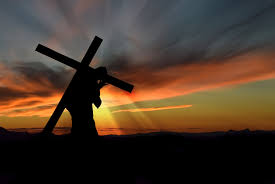
Mark.8,34 Then Jesus called the crowd, along with his disciples, and saidto them, “If anyone wants to become my follower, he must denyhimself, take up his cross, and follow me. 35 For whoever wantsto save his life will lose it, but whoever loses his life because ofme and because of the gospel will save it. 36 For what benefit is it for a person to gain the whole world, yet forfeit his life?
Adam was given a task to cultivate and protect the garden of Eden, it was a stewardship responsibility. This is used symbolically about the spiritual blessing, so as God’s co-workers we can plant and water, but God gives growth (1 Cor.3). We can build on the foundation of the gospel, but that is because God does his work with us in Christ Jesus. He has David’s key and it is then a manager’s task.
Rev.3,7 7 “To the angel of the church in Philadelphia write the following:
“This is the solemn pronouncement of the Holy One, the True One, who holds the key of David, who opens doors no one can shut, and shuts doors no one can open:
He is the king of kings and what does that mean? This means that they must humble themselves before him and pray for themselves and their people, learn from him what is right, so they learn to judge correctly and take the task of managing the natural resources in the country for the benefit of the entire people in the long term.
Isa.42,1 “Here is my servant whom I support,
my chosen one in whom I take pleasure.
I have placed my Spirit on him;
he will make just decrees for the nations.
2 He will not cry out or shout;
he will not publicize himself in the streets.
3 A crushed reed he will not break,
a dim wick he will not extinguish;
he will faithfully make just decrees.
4 He will not grow dim or be crushed
before establishing justice on the earth;
the coastlands will wait in anticipation for his decrees.”
Rev.17,14 They will make war with the Lamb, butthe Lamb will conquer them, because he is Lord of lords and Kingof kings, and those accompanying the Lamb are the called, chosen, and faithful.”
Rev.19,16 He has a name writtenon his clothing and on his thigh: “King of kings and Lord of lords.”
Where did the treasury in the Soviet Union go? So what was the ideology?
The fall of the berlin Wall.
Keynes’s economic theory was a success in Western Europe, it was clearly the opposite of Eastern Europe. In the 1980s, the Cold War ended with detente and agreements on the disarmament of nuclear weapons. Economic problems in East Germany then led to the fall of the Berlin Wall.
Quotation from https://www.britannica.com/video/events-announcement-revolution-Berlin-Wall-November-9-1989/-191811 :
NARRATOR: By 1989, the German Democratic Republic is on its knees. During the so-called Monday demonstrations, the people make known their dissatisfaction with the conditions in the GDR and call for reforms. Such reforms have already been introduced in the Soviet Union by the country’s premier, Mikhail Gorbachev, under the name of perestroika and glasnost. But the Central Committee and Politburo of the GDR’s ruling party, the SED, don’t hear the warning signs of the country’s demise and surge ahead with plans to celebrate the state’s 40th anniversary. Then, on the 9th of November, 1989, the unthinkable happens.
……
For 40 years, the people of the GDR lived without freedom. In the blink of an eye, their world came tumbling down. Without bloodshed, a revolution took place. People flowed across the inner-German border to be reunited with family and friends they hadn’t seen for decades. The 9th of November, 1989 has gone down in German history as the day the Wall fell. Not long after, the GDR’s regime was also consigned to the dustbin of history.
END OF QUOTATION.
In 1991, the Soviet Union also collapsed, due to economic problems.
Quotation from https://www.britannica.com/event/the-collapse-of-the-Soviet-Union :
collapse of the Soviet Union, sequence of events that led to the dissolution of the Soviet Union on December 31, 1991. The former superpower was replaced by 15 independent countries: Armenia, Azerbaijan, Belarus, Estonia, Georgia, Kazakhstan, Kyrgyzstan, Latvia, Lithuania, Moldova, Russia, Tajikistan, Turkmenistan, Ukraine, and Uzbekistan.
That the Soviet Union was disintegrating had been subtly apparent for some time, but the final act began at 4:50 PM on Sunday, August 18, 1991. Soviet Pres. Mikhail Gorbachev was at his dacha in the Crimeanresort of Foros when he was contacted by four men requesting an audience. They were his chief of staff, Valery Boldin; Oleg Baklanov, first deputy chairman of the U.S.S.R. defense council; Oleg Shenin, secretary of the Central Committee of the Communist Party of the Soviet Union (CPSU); and Gen. Valentin Varennikov, chief of the Soviet Army’s ground forces. They were accompanied by KGB Gen. Yury Plekhanov, chief of security for party and state personnel. Their unexpected arrival aroused Gorbachev’s suspicions, and, when he tried to use the phone, it was dead. They had come to demand, in the name of the State Committee for the State of Emergency in the U.S.S.R., that Gorbachev sign a document declaring a state of emergency and transferring power to his vice president, Gennady Yanayev. They were taken aback when Gorbachev refused and rebuked them as treasonous blackmailers.
………….
Tanks appeared on the streets of Moscow, and the city’s population immediately began attempting to dissuadetroops from obeying orders. Protesters began gathering around the White House, the Russian parliament building, and started erecting barricades. At 12:50 PMRussian Pres. Boris Yeltsin climbed atop a tank in front of the White House, condemned the coup and called for an immediate general strike. He later issued a presidential edict declaring the coup illegal and the plotters “criminals” and “traitors.” Russian officials were not to obey the orders of the Emergency Committee. At 5:00 PM Yanayev and the other coup leaders held a press conference. Yanayev claimed that the country had become “ungovernable” but hoped that his “friend President Gorbachev” would eventually return to his post. The president was “very tired” and was being “treated in the south,” Yanayev explained. He appeared visibly nervous, and his hands trembled during the presentation.
Yeltsin appealed to the patriarch of the Russian Orthodox Church, Aleksey II, to condemn the coup. The patriarch criticized Gorbachev’s detention and anathematized those involved in the plot.
…….
On August 20 Yeltsin issued a presidential edict stating that he was taking control of all military, KGB, and other forces in Russian territory. U.S. Pres. George H.W. Bush telephoned Yeltsin and assured him that normal relations with Moscow would resume only after Gorbachev was back in office. That night fighting broke out between troops and demonstrators near the White House, and three protesters were killed. The expected assault on the White House did not materialize, however, and it became clear that the coup leaders’ orders were not being obeyed. Belatedly, on August 21, the CPSU Secretariat demanded a meeting between Gorbachev and Yanayev. The coup collapsed, and the plotters were arrested while trying to flee. The U.S.S.R. Supreme Soviet reinstated Gorbachev and annulled all the decrees of the Emergency Committee. Yeltsin decreed that all enterprises in Russia were under his government’s control.
……..
The coup was the culmination of a conflict between the old and new political, economic, and social orders that had been under way since Gorbachev had risen to power in 1985. His perestroika and glasnost reforms had set in motion forces that were bound to collide at some point.
……..
END OF QUOTATION.
The collapse of the coup against Garbatshov.
Quotation from https://www.britannica.com/event/the-collapse-of-the-Soviet-Union :
The collapse of the coup led to the demise of Soviet communism, but the CPSU’s influence had been dwindling since at least the beginning of Gorbachev’s reform regime in 1985. The coup’s failure simply punctuated this decline by showcasing the hollow threat that the once-dominant Soviet apparat had become.
……
Yeltsin first rose to prominence in 1985 as an ally of Gorbachev, but he bristled at the slow pace of reform and soon found himself cast into the political wilderness. During his short time as the mayor of Moscow, however, Yeltsin won great popular acclaim as a champion of political and economic freedom. With Gorbachev’s introduction of democratic elections for the Soviet parliament, Yeltsin was returned to power with the overwhelming support of a Moscow constituency in 1989. The following year he was elected president of Russia over Gorbachev’s objections, and he immediately began advocating greater autonomy for the Russian republic. In anticipation of the passage of Gorbachev’s union treaty, Yeltsin set out to create an executive presidential system that would allow him to govern independently of parliament and the Communist Party hierarchies in republican and local government. He thus intended to correct the fatal error of Gorbachev, who had failed to forge an executive structure to implement the decisions of the U.S.S.R. Presidential Council and Security Council. Yeltsin’s executive powers rested on four pillars: the State Council, the Council of Ministers, the Council of the Federation and Territories, and the Security Council. The State Council bore the same name as the highest consultative body in Russia before 1917, a deliberate attempt to establish continuity with pre-Communist Russia.
………..
On December 25, 1991, Gorbachev announced his resignation of the presidency of the Soviet Union in a televised address. At 7:32 PM, less than a half hour after the conclusion of Gorbachev’s speech, the Soviet hammer-and-sickle flag was lowered from outside the Kremlinfor the final time. It was replaced by the prerevolutionary red, white, and blue tricolor of Russia. Russia succeeded to the U.S.S.R.’s permanent seat on the United Nations Security Council, and all Soviet embassies became Russian embassies. For six days, the Soviet Union continued to exist in name only, and at midnight on December 31, 1991, it was formally dissolved.
END OF QUOTATION.
There follows a period of conflict between the government and the parliament, until there was a threefold division of power, in executive, legislative and judicial power.
Oligarchs as remnants of an oligarchy.
But where did the treasury in the Soviet Union go? People in the Communist Party or with good contacts in the Communist Party shared it among themselves, through a tactical political game. Almost as if it were their private property. So that was how the dictatorship of the proletariat worked in practice. This was not righteous, but rather injustice in the system. The Communist Party became more like a mafia organization that shared the treasure among themselves. An injustice was done that did not provide a good basis for later cooperation with constructive thinking for community building. It was far from seeking first the kingdom of God and his righteousness. Shouldn’t the judiciary manage to clean this up?
It would probably have been more correct to see it as the common property of the people. A reasonable possibility would then be to distribute it to the people, so that everyone got the same. It would fit well with Keynes’s economic theory, compared to the Marshall aid, but then goods would also have to be available, otherwise the value would vanish by inflation. It had to be put into a closed account, so they could only withdraw a little per year for a reasonable time in the future. When they started with the market price, that is exactly what happened, there came high inflation and we know from before that this could be a problem for Keynes’s economic theory.
In the Soviet Union, the companies were state-owned, so the treasury was not just pure money, but companies that they shared between them, and that was a strange form of privatization. How could it go so quietly without protest? This was not fair! These companies should rather be nationalized in the states. Many of these companies were international for the national states, but it would have been possible to divide them into national departments or subsidiaries, with a common supranational administration. The central point would then be to use the values to build nationalities that stood for good management of natural resources. If they wanted to privatize state enterprises, it had to be done in a fairly decent and fair way.
The Soviet Union was ruled by the Communist Party, it was an oligarchy. The Soviet Union collapsed, yet the oligarchs are some strange remnants of the oligarchy.
Oligarchy.
Quotation from https://www.britannica.com/topic/oligarchy :
oligarchy, government by the few, especially despotic power exercised by a small and privileged group for corrupt or selfish purposes. Oligarchies in which members of the ruling group are wealthy or exercise their power through their wealth are known as plutocracies. Read about the rise of the Russian oligarchy in the wake of the collapse of the Soviet Union. Aristotle used the term oligarchia to designate the rule of the few when it was exercised…
END OF QUOTATION.
Russian oligarchs.
Quotatin from https://www.britannica.com/topic/Russian-oligarchs :
In Soviet times, state control of the economy was all-encompassing, from colossal reserves of oil and gas, timber, metals, and diamonds, to an archipelago of factories, refineries, and mines. The state set prices, owned all property, and controlled foreign trade. The economy was commanded by “red directors,” who ran the immense factories; Communist Party officials who supervised them; or the officers of the KGB, the Soviet secret police. But when Soviet leader Mikhail Gorbachev’s perestroika and glasnost reforms began to set off tremors of change in the late 1980s—allowing, among other things, the first private businesses—very few of the old guard remained in control. Rather, daring young men, from outside the power structure, unencumbered by old ways of thinking, seized the moment and became the first oligarchs.
On the day Gorbachev came to power in March 1985, it would have been impossible to pick out these future billionaires in a crowd.
………
How did they do it? The transition from socialism to capitalism was astonishingly fast. Yeltsin’s group of radical market reformers decided to free prices, property, and trade first, and install rules and institutions of a market economy only later. The result was that Russian capitalism was born into a vacuum without effective laws. In addition, the state was so badly weakened that it could not enforce laws that were on the books. Such a huge transition from socialism to capitalism all at once had never been attempted.
The young oligarchs learned how to take advantage of the hyperinflation that gripped Russia in the early 1990s. Rubles could be borrowed for 10 to 13 percent a year, but inflation was eroding their value at 25 percent a month. Consider a deal Berezovsky once struck. He agreed to buy 35,000 cars from the huge AvtoVaz factory. He paid for them over time in rubles, which lost their value due to hyperinflation. He had agreed to pay the ruble equivalent of $2,989 later for each car, but after two and a half years of inflation, he would pay back only the ruble equivalent of $360 for each. He sold them for $4,590 each.
The oligarchs became masters at manipulating the economic imbalances. They imported personal computers from abroad and sold them at a huge markup inside Russia; they exported oil and metals that they acquired cheaply inside the country and sold abroad for vast profits. Their banks became “authorized” to hold government deposits, such as payrolls, but instead of disbursing the money, they often kept it longer, reinvested it, and kept the profits.
Propping up the state
A major turning point came with privatization, which began in 1994. As a way to make all Russians feel that they had a stake in the state’s vast holdings, Russia distributed 148 million vouchers to its citizens. These could be traded for an employee’s shares of a company, deposited in mutual funds, or simply sold or exchanged. It sounded equitable, but in fact, the wealth was increasingly falling into the hands of a few, and the first oligarchs appeared. By 1996 the government was in dire financial straits, failing to collect enough tax revenue, and Yeltsin was running for reelection. In a major windfall for a handful of the oligarchs, the government borrowed the ruble equivalent of $1.8 billion from them and offered as collateralits shares in the crown jewels of Russian industry and natural resources. Later the collateral was delivered to the oligarchs in a series of rigged auctions. The notorious deals were known as “loans for shares” and marked the coming of age of the 1990s oligarchs. With their support, Yeltsin won a second term.
………
Yeltsin’s legacy was a people more free and entrepreneurial than any in Russian history; millions went abroad, voted, enjoyed a free press (in part owned by oligarchs) and learned to rely on themselves rather than the state. But civil society was fragile; moreover, Yeltsin failed to build rule-of-law to harness the freedoms he unleashed. Lying, stealing, and cheating were part of daily business; violence, brutality, and coercion were often tools of the trade. The oligarchs moved about in a world lacking the legal constraints or the moral compass of a mature Western society, but, nonetheless, they became billionaires.
They knew well they were unpopular among the Russian people, who suffered great dislocation in the 1990s; many Russians were impoverished by hyperinflation, others were unable to adapt to the dizzying pace of change. They looked critically at the tycoons with their flashy limos, mega-yachts, luxurious retreats, and overseas bank accounts.
………..
Putin, from oligarchy to autocracy.
Quotation from Quotation from https://www.britannica.com/event/the-collapse-of-the-Soviet-Union :
Yeltsin’s hand-picked choice as successor, Vladimir Putin, came to office with little understanding of either Gorbachev’s perestroika or Yeltsin’s wild 1990s. But Putin disdained the oligarchs and vowed to eliminate them as a class.
……..
Putin told the remaining oligarchs they could keep their assets, but he would tolerate no political challenge.
………
Putin went on to build a personalized autocracy. He enjoyed an economic boom because of rising oil prices until 2008, and he made a tacit pact with the Russian people: he would offer them better standards of living in exchange for their passivity in politics. Over time, he extinguished democratic institutions and civil society, the forces such as a free press, independent associations, churches and charities that are the connection between rulers and the ruled. Putin kept the oligarchic system in place but installed his cronies.
……….
Putin had begun with a soft authoritarian system but by the time of the February 2022 invasion of Ukraine, he led a dictatorship. Most of the wealthiest oligarchs around Putin were subject to Western sanctions after the war started. It was an uncomfortable time for those who once were the fleet-footed harbingers of a new era. Their luxury yachts, jets, mansions, and other assets were seized, and they were no longer welcome in Europe and the United States.
END OF QUOTATION.
Ukraine’s Oligarchs Are a Dying Breed. The Country Will Never Be the Same.
Quotation from https://carnegieendowment.org/russia-eurasia/politika/2022/09/ukraines-oligarchs-are-a-dying-breed-the-country-will-never-be-the-same :
It’s true that Ukraine’s oligarchs corrupted the Ukrainian state and undermined effective reform and development, preventing it from escaping from its post-Soviet stagnation. But they were also a key protective mechanism against anyone else usurping power.
It was not so long ago that the oligarchs and their relationship with the central government were a key element in Ukrainian politics. Their enormous capital that grew out of the corrupt privatization of Soviet industry on the eve of the 2000s influenced the most diverse aspects of the country’s political life, from the agenda set by the media to the makeup of parliament.
That has all changed, however, with the outbreak of war. With every passing day, the influence of Ukraine’s oligarchs is fading, and their capital alongside it. Without them, Ukraine is becoming a different country.
The process of deoligarchization, as it has become known, was already one of the biggest issues in Ukrainian politics in the year before the war. President Volodymyr Zelensky introduced a controversial law designed to limit the “excessive influence” of major tycoons, but the law was criticized both for its dubious legal status and for not going far enough.
Above all, there was no confidence that the young president would prevail in his confrontation with the country’s richest people: that the powerful oligarchs might not just decide to chip in to support the opposition and kick out Zelensky and his Servant of the People party at the next elections.
Then came Russia’s invasion, which the Ukrainian elite had refused to believe could happen right up until it did. Faced with an existential threat, internal squabbles were put on a back burner, and Zelensky went from a president whose popularity was in decline to supreme commander in chief. The oligarchs had to get in line with the new reality, and swiftly.
The outbreak of a full-scale war meant that for once Ukraine’s oligarchs were in the same boat as mere mortals. Just as with ordinary Ukrainians, their property could be destroyed by Russian missiles; their assets in the territory occupied by Russia are at risk of being appropriated; and their very lives are at stake: the grain magnate Oleksiy Vadatursky, number 24 on Ukraine’s Forbes list, was killed in July during the heavy shelling of the city of Mykolaiv. In these circumstances, it’s hardly surprising that most of the country’s oligarchs are donating enormous sums for defense and humanitarian needs, and not just for the PR.
The war is destroying the very foundation of the oligarchs’ economic might. Their most profitable assets—the metallurgy giants and mines of Donbas and Krivbas, the Black Sea and Azov Sea ports, and the most fertile agricultural land—are located in the southeast of the country, where the worst of the fighting is taking place.
……….
END OF QUOTATION.


