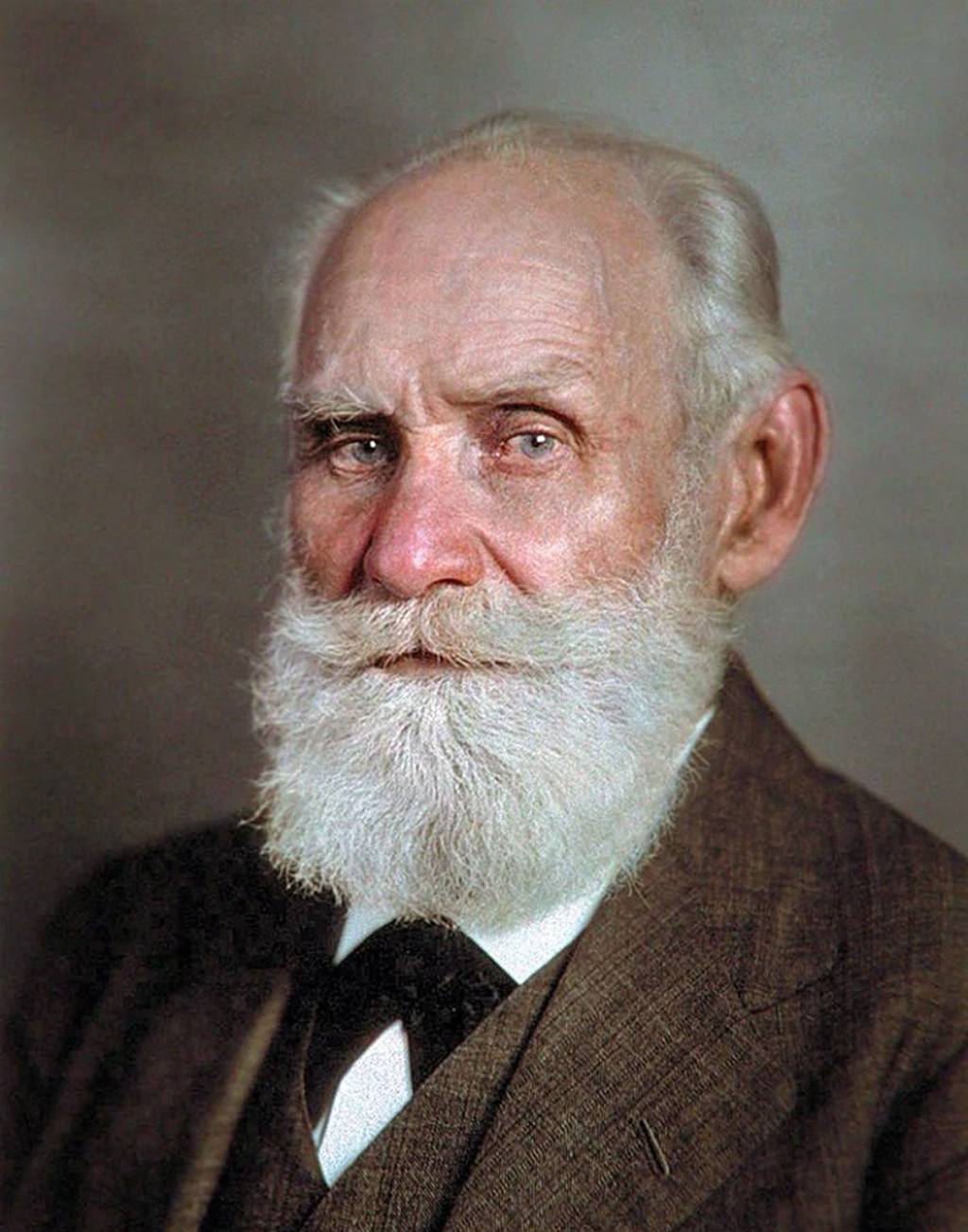
Image: Ivan Pavlov (1849-1936).
Objective or subjective and introspective psychology.
Quotation from Ivan Pavlov | Biography, Theory, Conditioning, Dog, & Facts | Britannica :
Ivan Pavlov (born September 14 [September 26, New Style], 1849, Ryazan, Russia—died February 27, 1936, Leningrad [now St. Petersburg]) was a Russian physiologist known chiefly for his development of the concept of the conditioned reflex. In a now-classic experiment, he trained a hungry dog to salivate at the sound of a metronome or buzzer, which was previously associated with the sight of food. He developed a similar conceptual approach, emphasizing the importance of conditioning, in his pioneering studies relating human behaviour to the nervous system. He was awarded the Nobel Prize for Physiology or Medicine in 1904 for his work on digestive secretions.
……
By observing irregularities of secretions in normal unanesthetized animals, Pavlov was led to formulate the laws of the conditioned reflex, a subject that occupied his attention from about 1898 until 1930. He used the salivary secretion as a quantitative measure of the psychical, or subjective, activity of the animal, in order to emphasize the advantage of objective, physiological measures of mental phenomena and higher nervous activity. He sought analogies between the conditional (commonly though incorrectly translated as “conditioned”) reflex and the spinal reflex.
The meaning of life.
Finding meaning in life, subjectively and/or objectively.
We need food and clothing, house and home and hopefully learn to work for it. There is meaning in that and gives life meaning. It is scientific and objective, just as science is objective knowledge. But most people have a greater perspective on life and make their choices to find more meaning in it. It is subjective and the freedom to make one’s subjective choices has then been there all the time, it is also fundamental, in comparison with our needs for food and drink. We have free will and it does not have much purpose to question it, but rather ask about what are wise choices, in order to have a good and meaningful life.
Metaphysics or propaganda?
Metaphysics is the doctrine of what is most fundamental, it can be traced back to the first Greek natural philosophers and to Plato and Aristotle. Plato searched in the world of ideas and it may be appropriate that God dwells in the high and holy and gave his answer by sending Jesus to our earth. Neoplatonism, barely 200 e.Kr, was a religious longing, more from the heart and got its answer by Jesus calling to him all who thirsted, with him they would drink of the living water, so it became in them a kettle that welled up to eternal life. It was God who was the source of the living water, so this is how they got to experience that he lived with them.
In this way, Augustine brought about a synthesis between Christianity and Platonism and it formed the basis for the Roman Empire legalizing Christianity and making it the state religion, so it had a great impact on history, especially in the Western world. He accepted a teaching that it is only through the church that man can be saved, it can agree with a biblical definition that the church is the one who is saved, but it is not given to man to decide who is saved, it is left to the individual to turn to Christ and be saved, so it is on an individual level and a subjective attitude, then it is Christ who knows it and then it is asked what the Holy Spirit convinces us of. It reveals God’s Word to us, so that we come to the realization of the Truth and become free and saved. It is not given to man to take a count of the saved, remember that when David wanted to take a census in Israel, he repented and humbled himself, but was allowed to choose the punishment, it became a pestilence (1.Kr 21). Remember that God had promised to make Israel as many as the stars in the sky and the sand on the shore of the sea, so many that they could not be counted. No, because no one can stop God’s Spirit with his counting. Augustine was called the father of the church, but it has no other father than God in heaven.
Metaphysics had its heyday in the universality controversy in the 1100s AD. In line with Platonism, there were many who believed that universal, perfect ideas existed and were valid, even if they were not physically visible. Others, like Aristotle, believed that such universals were only in the physical thing. Thomas Aquinas made a synthesis between Aristotelianism and Christianity, but which adds to the synthesis between Platonism and Christianity, by Augustine. The Catholic Church made “Thomism” its philosophy. Aristotle is called the father of logic, but made the mistake of applying it to physical objects instead of ideas, and this is what made the Catholic Church fight against the development of the new natural science. It was probably the case that moral philosophy and thus political philosophy was still connected to ancient mythology, where they believed that the constellations were gods. Though the prophets in the Old Testament had said long before, that it was not true, they said it precisely because many “scholars” and powerful people in their time worshipped the “heavenly army” as gods. They were proud and powerful, so they despised the prophets as unlearned and stupid, but it was pride that stood for the fall.
But the new natural science won out, there was discussion about the methods instead and it was eventually clarified, it was hypothetically deductive. Since then, there are many who have despised metaphysics as meaningless and useless, but what about the fundamtal questions, have we got the right answers to them? Like what is the meaning of life, what is truth. What is objective knowledge and what is subjective faith and insight, Do we have soul, do we have free will, can we be free, what is freedom? Christianity has long since given us the answer to this. So why should we not be able to know this? It tells us how we can be saved for eternity and have eternal life and that should be the most important thing for us!
The criticism of positivism was that it made the human being a tool for those who had power in society, but those who were called positivists in the positivism controversy called themselves critical rationalists, and I understand their position as defenders of the methods in the natural sciences, “the hypothetical deductive method”. In basic research, we find something that we can call objectively right and true, because it stands the test of time. In applied research, we can use it to construct things, tools that are useful to us. It works and thus testifies to the knowledge, so that we can still claim it to be objective. We have got better tools, so that productivity is greater and we have better prosperity.
According to Marxism, the workers become alienated, so that they no longer understand this and become powerless under the means of production. As if they themselves are taught to be tools for those who have power over the means of production. Yes, but that is what they are paid for. Hence it is for their own benefit. It is not trickery, even if they do not understand everything in the production processes. But the question is whether they in the rest of society are reduced to being tools for others, so that you become like slaves for others. But it is precisely here we need Christianity as a liberating message, in that it gives us a more fundamental meaning in life. Christ is our savior and Lord, he is life and gives us meaning in life. He came to give us life and life in abundance and there is meaning in that (Joh.10).
But the fundamental questions are still important to us and they return, but it is still only the Bible and Christianity that give the right answers. It is possible to try to believe and then search to find out, the point is to search in the right place, look and you will find, knock on the door and it will be opened for you, pray, and you will receive.
Constructivism is an educational perspective, where the student and the teacher construct the knowledge, so that it is man-made. So does the researcher. But then it is turned into philosophical ideology, with the claim that knowledge is only a human construction, so truth and objective knowledge do not exist. When such “knowledge” is used to answer the fundamental questions, it becomes even more meaningless than metaphysics with its pondering and speculation. It becomes even harmful.
It may seem that a group of people agree on a knowledge that they call moral philosophy, political philosophy or practical politics. They call themselves an elite that will rule over others, so it is important to stay inside. Others are excluded because they think differently and therefore they are considered stupid, the kind that the elite must rule over. Those who are outside can even be prejudged and then they do not get the opportunity to answer for themselves. With the constructivist perspective, it is denied that there is truth and objective knowledge, which they can use in their defense. They can even write about someone who is outside, so that their poetry comes as a substitute for the life expression of him and/or her. They demand to gain power over other people with their poetry, it is like with the fictional idols. In the Old Testament, the idols, made of sticks and stones, are called The Lie, the Devil is the Liar. In contrast, Jesus is the Truth that sets us free from bondage to sin and idols.
John 10: 1 “Truly, truly, I say to you, he who does not enter the sheepfold by the door but climbs in by another way, that man is a thief and a robber.
2 But he who enters by the door is the shepherd of the sheep.
3 To him the gatekeeper opens. The sheep hear his voice, and he calls his own sheep by name and leads them out.
4 When he has brought out all his own, he goes before them, and the sheep follow him, for they know his voice.
5 A stranger they will not follow, but they will flee from him, for they do not know the voice of strangers. ”
6 This figure of speech Jesus used with them, but they did not understand what he was saying to them.
7 So Jesus again said to them, “Truly, truly, I say to you, I am the door of the sheep.
8 All who came before me are thieves and robbers, but the sheep did not listen to them.
9 I am the door. If anyone enters by me, he will be saved and will go in and out and find pasture.
10 The thief comes only to steal and kill and destroy. I came that they may have life and have it abundantly.
11 I am the good shepherd. The good shepherd lays down his life for the sheep.
12 He who is a hired hand and not a shepherd, who does not own the sheep, sees the wolf coming and leaves the sheep and flees, and the wolf snatches them and scatters them.
13 He flees because he is a hired hand and cares nothing for the sheep.
14 I am the good shepherd. I know my own and my own know me,
15 just as the Father knows me and I know the Father; and I lay down my life for the sheep.
16 And I have other sheep that are not of this fold. I must bring them also, and they will listen to my voice. So there will be one flock, one shepherd.
17 For this reason the Father loves me, because I lay down my life that I may take it up again.
18 No one takes it from me, but I lay it down of my own accord. I have authority to lay it down, and I have authority to take it up again. This charge I have received from my Father. ”
Jesus is the Life, He gives us spirit and life in abundance, it is liberating and gives us meaning in life.
In the creation stories it is told that God created all things and did His work with His Word and His Spirit, so it is most fundamental. Naturally enough, reproduction is fundamentally important for a species to survive, as also with humans. Genesis 2 is a separate creation story about just that, it tells that God created the love relationship between man and woman, marriage and family life, naturally it is the most fundamental social unit in the people and society. Adam was to cultivate and protect God’s garden and that was what his wife was to help him with, so it gave meaning to life.
According to natural science, man is the most high-ranking mammal with the most care for his children. What further distinguishes humans is the ability to use tools, with the well-developed thumb. But what distinguishes them most, is the ability to think symbolically, with the sense of language and the sense of mathematics. In God’s Word there is a lot of symbolism and we need it to develop the sense of language in order to grasp the more lofty meaning he has for our lives, so the creation story itself in Genesis 2 has a symbolic interpretation.
Finding meaning in life may seem easy to many, as having a useful and meaningful job, but it is also a fundamental question with significance for eternity.
Ecclesiastes 3:9 What gain has the worker from his toil?
10 I have seen the business that God has given to the children of man to be busy with.
11 He has made everything beautiful in its time. Also, he has put eternity into man’s heart, yet so that he cannot find out what God has done from the beginning to the end.
12 I perceived that there is nothing better for them than to be joyful and to do good as long as they live;
13 also that everyone should eat and drink and take pleasure in all his toil—this is God’s gift to man.
14 I perceived that whatever God does endures forever; nothing can be added to it, nor anything taken from it. God has done it, so that people fear before him.
15 That which is, already has been; that which is to be, already has been; and God seeks what has been driven away.
Jesus said to the Jews that when those who were eval knew how to give their children good gifts, how much more will the Father give the Holy Spirit to those who ask him.
Matthew 7:7 “Ask, and it will be given to you; seek, and you will find; knock, and it will be opened to you.
8 For everyone who asks receives, and the one who seeks finds, and to the one who knocks it will be opened.
9 Or which one of you, if his son asks him for bread, will give him a stone?
10 Or if he asks for a fish, will give him a serpent?
11 If you then, who are evil, know how to give good gifts to your children, how much more will your Father who is in heaven give good things to those who ask him!
So he started by talking about what was natural and used it symbolically, to tell something that is more high and thus more fundamental, something that is eternal.
But when we seek fellowship with God on the basis of the gospel, it is not difficult to find the fundamental and right meaning of life as well, because Jesus is life, so He gives us meaning in life.
Matthew 11:25 At that time Jesus declared, “I thank you, Father, Lord of heaven and earth, that you have hidden these things from the wise and understanding and revealed them to little children;
26 yes, Father, for such was your gracious will.
27 All things have been handed over to me by my Father, and no one knows the Son except the Father, and no one knows the Father except the Son and anyone to whom the Son chooses to reveal him.
28 Come to me, all who labor and are heavy laden, and I will give you rest.
29 Take my yoke upon you, and learn from me, for I am gentle and lowly in heart, and you will find rest for your souls.
30 For my yoke is easy, and my burden is light. ”
This may come into conflict with worldly authorities, “learned” people, especially in moral philosophy and religion, but then Christ is the Truth that sets us free. He chose what is nothing, to put to shame the wise and strong. He gave us the Holy Spirit from heaven, who reveals God’s Word to us and leads us to the Truth that sets us free. We get to experience that God does His work in us through His Word and His Spirit.
In the Old Testament, a lot of history is told that is like the creation and the fall all over again, so also with the history of Israel. “Mother Israel” was God’s wife, so her children were supposed to be God’s children. But she did not realize that and became a whore by worshipping the idols of the people around her instead. Therefore, she was punished, so they were carried away from the land.
Isaiah was a prophet at the time when the Assyrians took the northern kingdom and Samaria fell (722 f.Kr), and he also prophesied that the Babylonians would conquer the southern kingdom and Jerusalem. It was God who punished them for their apostasy. Nevertheless, Isaiah said that God dwells in the high and holy and with the one who is broken and bowed down in spirit.
Isaiah 57: 14 And it shall be said, “Build up, build up, prepare the way, remove every obstruction from my people’s way. ”
15 For thus says the One who is high and lifted up, who inhabits eternity, whose name is Holy: “I dwell in the high and holy place, and also with him who is of a contrite and lowly spirit, to revive the spirit of the lowly, and to revive the heart of the contrite.
16 For I will not contend forever, nor will I always be angry; for the spirit would grow faint before me, and the breath of life that I made.
They were crushed and humiliated by their was conquered and they were carried away to Babylonia, but then he had mercy on those who humbled themselves before him and allowed them to return to their land.
Furthermore, this works as a Messiah prophecy, because God sent Jesus to them, he is called Immanuel, “God with us”, it came in fulfillment of verse 15, those who humbled themselves before God got to experience that he lived with them.
Since Christ died instead of us on the cross, we should see it as we are crucified and died with Him and in baptism we are buried with Him. There we are also raised with Him, by the power of God who raised Him from the dead. The body is dead and buried, but Jesus gives us spirit and life from heaven (John 6) and raises us up to life in fellowship with Himself and the Father.
When there was division in the congregation, Paul asked whom they were baptized to.
1 Cor.1: 10 I appeal to you, brothers, by the name of our Lord Jesus Christ, that all of you agree, and that there be no divisions among you, but that you be united in the same mind and the same judgment.
11 For it has been reported to me by Chloe’s people that there is quarreling among you, my brothers.
12 What I mean is that each one of you says, “I follow Paul, ” or “I follow Apollos, ” or “I follow Cephas, ” or “I follow Christ. ”
13 Is Christ divided? Was Paul crucified for you? Or were you baptized in the name of Paul?
14 I thank God that I baptized none of you except Crispus and Gaius,
15 so that no one may say that you were baptized in my name.
16 (I did baptize also the household of Stephanas. Beyond that, I do not know whether I baptized anyone else. )
17 For Christ did not send me to baptize but to preach the gospel, and not with words of eloquent wisdom, lest the cross of Christ be emptied of its power.
Christ the Wisdom and Power of God
18 For the word of the cross is folly to those who are perishing, but to us who are being saved it is the power of God.
19 For it is written, “I will destroy the wisdom of the wise, and the discernment of the discerning I will thwart. ”
20 Where is the one who is wise? Where is the scribe? Where is the debater of this age? Has not God made foolish the wisdom of the world?
21 For since, in the wisdom of God, the world did not know God through wisdom, it pleased God through the folly of what we preach to save those who believe.
22 For Jews demand signs and Greeks seek wisdom,
23 but we preach Christ crucified, a stumbling block to Jews and folly to Gentiles,
24 but to those who are called, both Jews and Greeks, Christ the power of God and the wisdom of God.
25 For the foolishness of God is wiser than men, and the weakness of God is stronger than men.
But then we learn that the Spirit of God also makes the body alive and then we are to offer it as a living, holy sacrifice to God, that is the spiritual ministry of our God.
Rom.8: 8 Those who are in the flesh cannot please God.
9 You, however, are not in the flesh but in the Spirit, if in fact the Spirit of God dwells in you. Anyone who does not have the Spirit of Christ does not belong to him.
10 But if Christ is in you, although the body is dead because of sin, the Spirit is life because of righteousness.
11 If the Spirit of him who raised Jesus from the dead dwells in you, he who raised Christ Jesus from the dead will also give life to your mortal bodies through his Spirit who dwells in you.
Heirs with Christ
12 So then, brothers, we are debtors, not to the flesh, to live according to the flesh.
13 For if you live according to the flesh you will die, but if by the Spirit you put to death the deeds of the body, you will live.
14 For all who are led by the Spirit of God are sons of God.
15 For you did not receive the spirit of slavery to fall back into fear, but you have received the Spirit of adoption as sons, by whom we cry, “Abba! Father! ”
16 The Spirit himself bears witness with our spirit that we are children of God,
17 and if children, then heirs—heirs of God and fellow heirs with Christ, provided we suffer with him in order that we may also be glorified with him.
Rom.12: 1 I appeal to you therefore, brothers, by the mercies of God, to present your bodies as a living sacrifice, holy and acceptable to God, which is your spiritual worship.
2 Do not be conformed to this world, but be transformed by the renewal of your mind, that by testing you may discern what is the will of God, what is good and acceptable and perfect.
Gifts of Grace
3 For by the grace given to me I say to everyone among you not to think of himself more highly than he ought to think, but to think with sober judgment, each according to the measure of faith that God has assigned.
4 For as in one body we have many members, and the members do not all have the same function,
5 so we, though many, are one body in Christ, and individually members one of another.
6 Having gifts that differ according to the grace given to us, let us use them: if prophecy, in proportion to our faith;
7 if service, in our serving; the one who teaches, in his teaching;
8 the one who exhorts, in his exhortation; the one who contributes, in generosity; the one who leads, with zeal; the one who does acts of mercy, with cheerfulness.
1 Cor.12: 12 For just as the body is one and has many members, and all the members of the body, though many, are one body, so it is with Christ.
13 For in one Spirit we were all baptized into one body— Jews or Greeks, slaves or free—and all were made to drink of one Spirit.
14 For the body does not consist of one member but of many.
15 If the foot should say, “Because I am not a hand, I do not belong to the body, ” that would not make it any less a part of the body.
16 And if the ear should say, “Because I am not an eye, I do not belong to the body, ” that would not make it any less a part of the body.
17 If the whole body were an eye, where would be the sense of hearing? If the whole body were an ear, where would be the sense of smell?
18 But as it is, God arranged the members in the body, each one of them, as he chose.
19 If all were a single member, where would the body be?
20 As it is, there are many parts, yet one body.
21 The eye cannot say to the hand, “I have no need of you, ” nor again the head to the feet, “I have no need of you. ”
22 On the contrary, the parts of the body that seem to be weaker are indispensable,
23 and on those parts of the body that we think less honorable we bestow the greater honor, and our unpresentable parts are treated with greater modesty,
24 which our more presentable parts do not require. But God has so composed the body, giving greater honor to the part that lacked it,
25 that there may be no division in the body, but that the members may have the same care for one another.
26 If one member suffers, all suffer together; if one member is honored, all rejoice together.
27 Now you are the body of Christ and individually members of it.
28 And God has appointed in the church first apostles, second prophets, third teachers, then miracles, then gifts of healing, helping, administrating, and various kinds of tongues.
29 Are all apostles? Are all prophets? Are all teachers? Do all work miracles?
30 Do all possess gifts of healing? Do all speak with tongues? Do all interpret?
31 But earnestly desire the higher gifts. And I will show you a still more excellent way.
So when Jesus by His Spirit makes our bodies alive, we become members of Jesus’ body and that is Jesus’ church. Usually we think of the church as an organization and then we have many Christian organizations that also have their prayer houses and meeting rooms. But the biblical definition of Jesus’ church is that we become like spiritual stones built up into a spiritual temple and our bodies function as members of Jesus’ body.
1 Peter 2,1 So put away all malice and all deceit and hypocrisy and envy and all slander.
2 Like newborn infants, long for the pure spiritual milk, that by it you may grow up into salvation—
3 if indeed you have tasted that the Lord is good.
4 As you come to him, a living stone rejected by men but in the sight of God chosen and precious,
5 you yourselves like living stones are being built up as a spiritual house, to be a holy priesthood, to offer spiritual sacrifices acceptable to God through Jesus Christ.
6 For it stands in Scripture: “Behold, I am laying in Zion a stone, a cornerstone chosen and precious, and whoever believes in him will not be put to shame. ”
7 So the honor is for you who believe, but for those who do not believe, “The stone that the builders rejected has become the cornerstone, ”
8 and “A stone of stumbling, and a rock of offense. ”They stumble because they disobey the word, as they were destined to do.
9 But you are a chosen race, a royal priesthood, a holy nation, a people for his own possession, that you may proclaim the excellencies of him who called you out of darkness into his marvelous light.
10 Once you were not a people, but now you are God’s people; once you had not received mercy, but now you have received mercy.
11 Beloved, I urge you as sojourners and exiles to abstain from the passions of the flesh, which wage war against your soul.
12 Keep your conduct among the Gentiles honorable, so that when they speak against you as evildoers, they may see your good deeds and glorify God on the day of visitation.
What was the conclusion of the universal dispute?
At the time of the Universal Dispute after 1100 e.Kr, metaphysics was given a period of its heyday, but after the discovery of the new natural science with its method, many people concluded that this discussion was meaningless and useless and so was metaphysics. But didn’t that mean that a conclusion was drawn and if so, what was it?
Platonic realism was that invisible ideas exist, even if they are not visible, they can be perfect, like a circle that is exactly a circle, so also with the idea of the good. Thus there was a link between mathematics and moral philosophy. Aristotelian realism was that ideas exist, but only in the physical thing. Thomism included both, so it agreed with Aristotle that universalia exists in the thing, but he was wrong that they exist only in the physical thing. Both are called realism, because universalia exists, same to whether we sense and experience it or not, regardless of whether we sleep or are awake and conscious and perceive it or not. Same whether we are alive or dead.
After the discovery of the new natural science, this must still be the conclusion! Universalia is not only in the thing, but outside the thing as well. Take, for example, the field theory, electric and magnetic fields, and gravitational fields. It is true that it depends on a thing that sets up the field outside of it, but when a thing emits light, then the light is only electric and magnetic fields, which are no longer conditioned by the thing that emitted it. And then comes the wave equation in Hilbert space (quantum physics).
But rationalism is to claim that we sense and experience it (Aristotelian rationalism), we can gain insight into the universal ideas and understand it (Platonic rationalism). Then the only question is how much we understand. Kant claimed that the rationality of the church does not exist, but rationality is not only a question of existence, as with realism, but also a question of how much we understand. The church was admittedly completely on the wrong track, she had fallen away from the Father and the Son and found another “rationality” instead, one that admittedly did not exist. Compared to this, the new natural sciences with their methods were on the right track.
The right issue then becomes how this fits with true Christianity, the one we find in the Bible. That we are reconciled to God on the basis that Jesus died instead of us. All who received him he gave the right to become God’s children, born of the water of life and God’s Spirit and what is born of the Spirit is spirit. Christ is the way to the Father, by walking that way, we come into fellowship with the Father and the Son, so that we can experience that he loves us and cares for us as his children, so that he raises us up and teaches us. He meets us at our level and teaches us and then there is a growth where we grow up to He who is the head of the body, which is his church.
We believe and claim that God and His Word exist, God is spirit and his kingdom is a spiritual reality, it is invisible, like a perfect idea, so we can call it Platonic realism. The rationality is that we can have and gain insight into it and learn to understand, then it is only a question of how much we understand. Still our faith goes beyond that. The important point then becomes to learn to pray, we must learn to start with the most fundamental, ask the Father to give us the Holy Spirit, let us reconcile with God on the basis of the gospel, then we receive the Holy Spirit through faith in Jesus, by grace alone.
What about the constructivist pedagogical perspective? It placed a language symbol between stimulus and response, so it functioned as a second stimulus. Well, so there we place God’s Word! Jesus is God’s Word and we believe in Him, through faith in Him we receive the Holy Spirit and it reveals the Word to us, so that we realize and acknowledge that Jesus is the Truth that sets us free. We bow down to Him and thank Him as our Savior and Lord, thank Him for salvation and rejoice in the Lord. Then He will give us what our heart desires. I have asked Him to give me a saved woman as a wife and expect that He will give it to me.


