
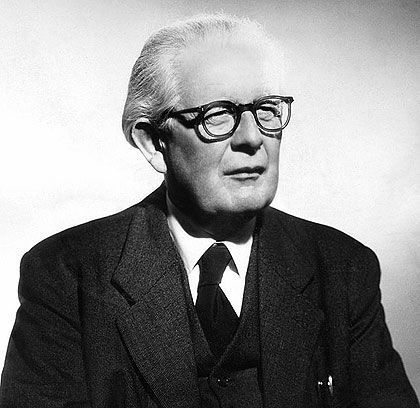
Image: Piaget (1896–1980) was from Switzerland and earned a doctorate in biology at the age of 22. He later became famous for his educational theory, which is characterized as cognitive constructivism.
Theological, scientific and pedagogical method.
William Ockham, Science and Religious Life.
With modern natural science, there was controversy about the method and the conclusion was that the method was hypothetically deductive. Hypothesis and theory were rationality on which logic and mathematics could be applied and think deductively. But it was to be tested empirically, thus there was a synthesis between rationality and empiricism.
In the natural sciences, scientific method has also been used as a pedagogical method, we should be reassured for it, we should be given good explanations and that are thus good pedagogy. Especially when using experiments. For example, a good and simple explanation of what quantum physics is to refer to the double-slit experiment or do it.
The monk Wilhelm Ockham came with a good advice called Ockham’s razor, quote from Ockham’s razor – Store norske leksikon :
Occam’s razor, principle stated by the Scholastic philosopher William of Ockham (1285–1347/49) that pluralitas non est ponenda sine necessitate, “plurality should not be posited without necessity.” The principle gives precedence to simplicity: of two competing theories, the simpler explanation of an entity is to be preferred. The principle is also expressed as “Entities are not to be multiplied beyond necessity.” The principle was, in fact, invoked before Ockham by Durandus of Saint-Pourçain,
END OF QUOTE.
He made a clear distinction between scientific investigation and his life with God, yes, because God is spirit, but nature is stone, trees, earth, and such things that are made of earth, it is something other than He who created it. God is spirit and has power over nature He has created and can do miracles, but if He did miracles in our scientific experiment, He would destroy it for us. It would be as if He was cheating in the experiment.
But when we seek fellowship with God on the basis of the gospel, we get to experience that God who is spirit does His work with us, with His Word and His Spirit. Then we can experience that God does miracles through His Spirit and then we have to thank God and the Lamb for that. God is spirit and He has touched us with His Spirit, that is the right explanation. Then it is just for us to go out and testify about Him, as the disciples did when the Holy Spirit came upon them on the day of Pentecost. And like this was the charismatic revival in the 1970s.
God does not give His glory to idols, which are made of sticks and stones, nor to man who tries to make himself like God. If anyone does, they do not tell the Truth. The idols are lies and the Devil is the Liar, but Jesus is the Truth who came to set us free from bondage to sin and idols and to give us childhood with God.
Behaviorism.
Behaviorism is the classic pedagogical theory. It sounds like it’s about behaving, so it should probably fit with learning how to do practical work. Pavlov had some dogs and then he started to give a signal before he gave them food. Then he noticed that when he gave the signal, they started drooling for food. The stimulus was food, the response was drooling, but now the signal was called conditioned stimulus and the response was also conditional. That’s how they had learned something. They were stimulated and gave a response, that’s how these learning theories are and they have clear hedonic features, you likely reject what feels bad and choose what feels good. In this way, it is closer to a mechanistic world picture.
But if the other learning theories come up with something else in addition, then the question is whether the students are just fooled by it.
The positivism debate.
Logical positivism came in the 1920s, clearly intended as a refreshment of empiricism or the hypothetical deductive method, quote from Logical positivism | Philosophy of Science, Language & Knowledge | Britannica :
logical positivism, a philosophical movement that arose in Vienna in the 1920s and was characterized by the view that scientific knowledge is the only kind of factual knowledge and that all traditional metaphysical doctrines are to be rejected as meaningless. A brief treatment of logical positivism follows. For full treatment, see positivism: Logical positivism and logical empiricism. Logical positivism differs from earlier forms of empiricism and positivism ….
END OF QUOTE.
Quote from Positivism | Definition, History, Theories, & Criticism | Britannica :
positivism, in Western philosophy, generally, any system that confines itself to the data of experience and excludes a priori or metaphysical speculations. More narrowly, the term designates the thought of the French philosopher Auguste Comte (1798–1857). As a philosophical ideology and movement, positivism first assumed its distinctive features in the work of Comte, who also named and systematized the science of sociology. It then developed through several stages known by various ……
END OF QUOTE.
Some of those who claimed to defend positivism, actually call themselves critical rationalists, so their method was clearly hypothetically deductive, quote from The Positivism Controversy – Wikipedia:
Critical rationalism is Karl Popper‘s answer to what he considered the most important problems of epistemology and philosophy of science: the problems of the growth of knowledge, notably by induction, and the demarcation of science. He adopted a fallibilist approach to these problems, especially that of induction, without falling into skepticism. His approach was to put in perspective the distinctive role of deductive logic in the development of knowledge, especially in science, in the context of a less rigorous methodology based on critical thinking. The central technical concept in the application of critical rationalism to science is falsifiability. Popper first mentioned the term “critical rationalism” ……..
Fallibilism, not skepticism
Popper admitted that the truth of statements cannot be obtained using only logical definitions and deductions, as this leads to an infinite regress.[5] For Popper, this does not prevent statements from being useful for solving problems, because they can be logically analyzed to draw logical consequences, possibly contradictions with observation statements linked to real tests.[5] Popper wrote that the bulk of scientific activities use deductive logic to evaluate theories.[6][7][8]
Popper accepted Hume‘s argument and the consequences of Duhem’s thesis and insisted that there is no logical method for accessing empirical truth, no inductive rule, not even to a small extent. However, he rejected skepticism, the idea that the search for truth is futile. He admitted that, although logic alone says nothing about empirical truth, statements can be related to reality through problem solving, scientific observations and experiments.[9] Popper always insisted on this distinction between the logical aspect and methodological aspect of science.[10][11] In Realism and the Aim of Science, Popper speaks of a “preferred” theory, not of a “true” or a “false” theory, when one theory is chosen over another given experimental results.
END OF QUOTE.
In the 1800s, there was a distinction between social studies and natural sciences. We can well compare it to Ockham’s distinction between his life with God and scientific interest and investigation. He was a monk and they often lived a secluded life from society. Their mission was to go out with the gospel, so this was their social involvement.
The positivism controversy came as a dispute between the methods in the social sciences and in the natural sciences in that many imagined that they could have the same method, but the methods in the natural sciences had long since been clarified, they provided objective and certain knowledge with good insight, even though it could and had to be improved, with such methods, but sometimes they discovered that a completely new theory was needed, for example quantum physics. The usual view then is to claim that the old one was wrong, so a new one was needed, such is the method, but we still have classical physics, even if quantum physics and the theory of relativity are in addition. It is not correct to conclude that the methods are wrong, that it does not provide objective knowledge. Quantum physics is at the nano level and it appears in the macrocosmos in certain special cases that we like to use as an experiment. I have a certain belief that it shows up in living creatures as well, for example by us having free will. This is in contrast to “the mechanistic human view”.
But it is in the social sciences that the problem lies, especially in that they hooked themselves into “the mechanistic universal view”, despite the fact that the pioneers who developed classical mechanics did not, because both Galileo and Newton believed in Christianity. Since then, we have electromagnetism as well, so I assume that is why they talk about” the physicalistic view of man” instead. But what quantum physics means for the view of man is still a mystery.
Hans Skjervheim.
Quote from Hans Skjervheim – philosopher and non-fiction writer:
In the 1960s, Skjervheim was active as a critic of positivism. In writings from this period, he dealt with certain forms of sociology. What he then focused on was the implicit philosophy of science.
From the 1800s onwards, there was a split between the natural sciences and the human sciences. Skjervheim entered into this issue via the social sciences, which just after the Second World War were coloured by objectivist approaches. Skjervheim’s point was that the philosophical ideas in sociology in the 1950s and 1960s prevented social scientists from getting in touch with social reality. What he criticised was scientism, the then prevailing positivist philosophy. On the basis of phenomenology and philosophy of existence, he showed the relevance of the problem of understanding and interpretation in the social sciences. This happened in the circle around Professor Arne Næss, where impulses from the Viennese Chronicle and the idea of a unified science – a common method for all science – were cultivated. His main aim was to show that there is a fundamental difference between natural phenomena and social phenomena, and that there must therefore also be a fundamental difference between social science and natural science.
……
In the 1960s, Skjervheim introduced what he called the philosophy behind the student rebellion: Theodor W. Adorno, Max Horkheimer, Herbert Marcuse and Jürgen Habermas. But in the same way as Habermas in Germany, he warned against political dogmatism. When Maoists, Leninists and Stalinists took over parts of the debate at Norwegian universities, Skjervheim became more and more critical of the foundation of it all, namely Marxism. In the 1970s, he warned strongly against dogmatism in political theory, and he reacted strongly against the intellectual climate he encountered at Roskilde University Centre in the mid-1970s. He warned against what he saw as the consequences of the long march of the left-wing radicals through the institutions, especially the university political consequences.
He addressed this topic in several ways, including by discussing the limits of ideology criticism in the book Ideology Analysis, Dialectics, Sociology (1973). He also formulated a critique of Marx’s theory of value, and he helped introduce the French neo-philosophers’ criticism of Marx in Norwegian in 1978. At this time he was affiliated with the Marxism-critical journal Kontinent Skandinavia. He claimed that parts of the left used Marxist dogmas to prevent free discussion and observed that valid insights from the positivism controversy were compromised through political orthodoxy.
…….
Pedagogy
Skjervheim was primarily concerned with fundamental questions in the new social sciences that had an increasing impact at Western universities in the 1950s and 1960s. He argued that sciences that studied human beings had to be based on philosophical reflection in a different sense than natural science. The same applied to academic and professional activities involving human beings who had to develop a subject-subject relationship in which all parties participate in a dialogue.
On the basis of such a principled view, Skjervheim delivered a fundamental critique of what he believed to be a dominant instrumentalism in the prevailing pedagogy at the Institute of Educational Research, University of Oslo. The main argument was that instrumentalist use of knowledge was a means of influencing pupils and students so that they adapted to the will of others without taking responsibility themselves. Skjervheim called such teaching “persuasion”, and launched as a critical alternative a teaching method that was instead based on “convincing”. Where the purpose was to convince others, both parties had to have the status of independent subjects, and not be part of an asymmetrical relationship where the teacher was the only subject who treated the pupil as an object. Skjervheim could refer here to the Socratic dialogue, which he highlighted as an example of intellectual, factual and knowledge-based dialogue.
For Skjervheim, the content of a pedagogical dialogue was just as important as the subject-subject relationship. He also criticised what he called “free growth pedagogy”, where free expression was more important than a matter that was partly distinguished between true and false, and where the purpose was to encompass valid, well-founded knowledge. Skjervheim’s view of pedagogy has had a significant impact on the development of this subject.
Postmodernism and goal management
In the 1980s, Marxism had in practice played its role at the universities. Skjervheim allowed himself to be challenged by two seemingly opposing currents. He criticized postmodern theories for inviting a form of scepticism that undermined intellectual life. And he attacked the use of economic models used in areas where they did not need to, for example in universities, health care, and so on. In both, he saw critical reason challenged, through principled scepticism or through practical anti-intellectualism.
END OF QUOTE.
Constructivism.
Constructivism is a theory both of what knowledge is and how learning takes place, it distances itself from the positivist view that knowledge exists as an objective truth and that it is possible to uncover it through sensory data and by constantly correcting it against sensory data. Constructivism believes that knowledge does not exist in itself, but only as a human product in our efforts to understand the world around us, knowledge is man-made. This is radical constructivism. A recurring question is how this construction takes place.
According to cognitive constructivism, learning takes place individually, through an interaction between the child and the physical nature around it. In social constructivism, learning takes place in social interaction, debate and discussion. Objective truth does not exist, instead knowledge is accepted jointly by researchers and scholars or in other ways through discourses. But knowledge does not exist in itself.
This is form our main teaching-book in pedagogy: Imsen, Gunn (2005) ELEVEN’s WORLD Introduction to Educational Psychology, fourth edition. University Press. Pages 227-228.
Piaget.
Jean Piaget (1896-1980) is the great educator in cognitive constructivism. He was from Switzerland and took a doctorate in biology already when he was 22 years old. He thinks of the mind as cognitive schemas in which we store the knowledge, it is assimilated into the schema and it sort of goes by itself in our daily lives. But then we encounter something that does not fit into the schema, so there is an imbalance in the schema. That he called it imbalance refers to biological processes, such as temperature difference that makes you freeze or sweat and react to it. You find that you have to rebuild your schema in order for it to accommodate the new knowledge, which is why it is called learning by accommodation. The learning was motivated by the imbalance, it is good pedagogy and this is important learning.
He included four stages in the child’s development,
1. Sensorimotor period, 0-2 years
2. Preoperative period, 2-7 years.
3. Concrete-operational period, 7-11 years.
4. Formal-operational method, from 11 years.
In the last period, they learn to think symbolically, and this is important in mathematics and when they later have to abstract, as we do in the hypothetical deductive method, but often it turns out that they need to become older before they master it. But it is important for them already when they are learning the multiplication table, then the teacher must take care of each individual student, so that none of them start to develop math difficulties, otherwise it can be difficult to do anything about it later.
Vygotsky.
Lev Vygotsky (1896-1934) was a Russian Jew and a pioneer of the sociocultural perspective. In the psychological milieu of Moscow in the 1920s, it became important to establish a new psychology on a Marxist basis, since Vygotsky was a scholar and well acquainted with Hegel’s philosophy, he became a leader in this work.
Compared to behaviorism, Vygotsky inserted a cognitive tool between stimulus and response, he called it a sign and it functioned as a 2nd order stimulus. Just as Pavlov’s dogs learned to respond to signals as conditioned stimuli, humans learn to replace the thing with linguistic symbols in their minds. That the language sign is inserted between stimulus and response is called mediation. The mediating helper between stimulus and response becomes important not only for learning, but for the entire culture, so this is called a sociocultural perspective on learning.
The teacher acts as the mediating helper, and it is important to meet the student and talk at the student’s level. We can think of the student as a circle. Outside of it, there is a limit to what the student can manage alone, and outside of it again, there is a limit to what the student can manage with the help of others. The area between these boundaries is called the proximal developmental zone.
Paulo Freire.
Paulo Freire was a Brasilian educator who also adhered to the sociocultural perspective and emerged as a “liberation educator” who collaborated with the Catholic Church in South America. Quote from Paulo Freire | Pedagogy, Critical Theory & Education Reform | Britannica :
Paulo Freire (born Sept. 19, 1921, Recife, Braz.—died May 2, 1997, São Paulo) was a Brazilian educator. His ideas developed from his experience teaching Brazil’s peasants to read. His interactive methods, which encouraged students to question the teacher, often led to literacy in as little as 30 hours of instruction. In 1963 he was appointed director of the Brazilian National Literacy Program, but he was jailed following a military coup in 1964. He went into exile, returning in 1979 to help found the Workers Party. His seminal work was Pedagogy of the Oppressed (1970). …….
END OF QUOTE.
Socrates believed that the Truth was integrated into him and made him happy and free. So is Christianity, but Jesus said that he was the Truth. But constructivism is reminiscent of the sophists, what can that result in then?
Ancient philosophy began as nature philosophy, but they did not find a method to decide what was right. Then moral philosophy and political philosophy became dominant. The scholars were called sophists, they were teachers, journalists and lawyers, “social scientists” that is. It was a limited democracy and they eventually believed that there was no morality that could be said to be right for everyone, no absolute morality, with clear opposition to the religious leadership. They worshipped idols, but from the very beginning the natural philosophers had imagined a God, more like the God of Israel.
Socrates went out and talked with people and asked them problems that would make them think. He himself believed that through such conversations he realized the truth and it was integrated into him and it made him happy, it set him free. This is referred to as good pedagogy, when the knowledge is integrated into you, then you learn.
Athens lost the war against Sparta and then there was a court settlement where the sophists were blamed for having misled the youth, so that societies decayed, therefore they lost the war, Even though Socrates said there was something that was true and right, in contrast to the sophists, he was also judged and executed. Socrates believed that the truth gave him an inner joy that made him endure the flames from the fire.
Plato believed that the execution of Socrates was a miscarriage of justice and this became important to him philosophizing. Christianity came as an apt answer to this. According to the Old Testament, the idols, made of stick and stone, are the Lie, the Devil is the Liar, as opposed to this Christ is the Truth that sets us free from bondage to sin and idols.
Metaphysics is the study of what is most fundamental, it has a tradition from the very beginning of ancient natural philosophy and had its heyday in the Universalist Dedbate from 1100 e.Kr. But with the new natural science in the 1600s, they found a method to find out what was right, so it went back sharply with the old, ancient gods. Many came to the conclusion that much of this discussion had been meaningless and useless. But shouldn’t the church know what was most fundamental? It was just a matter of reading the creation accounts in the Bible and continuing to read it so that they could get the gospel of Christ.
According to the constructivist, pedagogical perspective, knowledge is man-made, it is something that they agree on. Scientists agree on the basis of the repeatable experiment, so far it is a viable perspective, but that also means that it is objective knowledge. But constructivism is also an ideology that claims that objective knowledge does not exist, since it is man-made. So their philosophy is still like that of the sophists, despite the fact that we have now found a method to determine what is right. And despite the fact that we have now received the gospel of Christ, who is the Truth who sets us free and who has sent us the Spirit of Truth, so that it will lead us to the whole Truth.
Plato believed in the idea of the good, he thought mathematically to explain it, he had a problem with the idea of evil, but explained it as a lack of insight into the world of ideas. The rationalists of the 1600s took up the thread and claimed that we have a free will and are wise to choose the idea of the good.
Aristotle saw the mind as a clean slate, “tabula raste” as it is written on by us making experience in the material environment, empiricism that is. We encounter this again in liberalism, it claims human rights, including freedom of speech, but in the beginning it applied in practice only to the rich and powerful. Would the mind of the lower class be like “tabula raste” for them? But now they have become aware that a large part of our knowledge lies in the genes.
The Nazis’ propaganda is characterized as Goebbels’ slogan being “if a lie is repeated enough times, it eventually becomes a truth”. The “Metoo#” campaign gave the impression that the woman’s knowledge had its origin in a man touching her to make gendered approaches to her, like this is empiricism in psychology, psychiatry and social sciences. But there were no men who appeared in the “Me-Too#” campaign. It was something they agreed on, without the man in question having anything to say. So when a man tried to find a wife, it was a matter that he should have nothing to do with.
It shows that there were women who fantasized about men, in comparison to how “Mother Israel” fell away from the Lord and began to worship the idols of stick and stone instead. The Lord was spirit and touched her and cared for her, but he was not physically visible, the idols were, but they did not have spirit, they neither saw nor heard and did not give answers. In this way, the empirical experience is used as an argument against the belief in God who is spirit. Otherwise, empirical data is not of great importance in the social sciences, since they claim that there is no objective knowledge. They believe that knowledge is man-made and then they try to gain power over other people with their knowledge. It is as if they are trying to adore themselves with their knowledge. Paul said that they are not gods, but those who worship them can come into society with evil spirits.
It is clear that there is a collective discourse behind the climate policy, the “MeToo action”. Pride and Woke, so we understand that there is a form of socialist power interest behind it. It is presented as liberation and decolonization, but in reality it results in bondage and an alternative form of colonization. As if Greenland and Canada should continue to be European colonies, instead of being free and independent nations on the American continent, with the ability to cooperate with other free and independent nations on the same continent.
The American courts demand that you tell the truth and nothing but the truth, but with the constructivist perspective, you can say exactly what you want, as long as you don’t tell the truth.
Become strong in the Lord and His mighty power.
At a meeting in Maranata on 10.5.2009, Jesus spoke to us about what is now accepted and which is the kingdoms of darkness, quote from 2009.05.10. Maranata. Find the way to behold Jesus in his glory. – Blessing from heaven through faith in Jesus. ;
“I am able to fill every place and every meeting-room, today saith the Lord, though the enemy storms ever so much, though my people are on the side of what I really want to bring forth, though there is only a small number who will rise up from the kingdom which is now being accepted and which are the kingdoms of darkness and beginning to pass into my kingdom, if there be but a small number who find the way to see me in my glory, then with a small number I can do great things anywhere and at any time. The great multitude that I see, the multitude that devote themselves to me, that I may come down and begin to fertilize your faith and fertilize your love from me…. When these things begin to happen according to my will and counsel and you begin to receive my wisdom and my knowledge, then you will see that I am the living one and the one who can set all things in order. I am the one who paves the way, I am the one who allows my power to be revealed and paves the way for the individual who will go my way. There are many who go their way and who limp here and limp there. But I will have a whole heart, a pure mind, and you will see again that I am the same and I am the living one today.”
I went forward for prayer, and then a prophetic message came that wasn’t recorded. The Lord said that it was Him who had put the joy in me. It’s not from myself, it’s from Him, He is my Lord. He said that I should bring out this joy. He said it several times.
END OG QUOTATION.
There is nothing to prevent us from using constructivism as a pedagogical perspective. I have a taste for Piaget’s pedagogical theory and can point to many cases that can be characterized as having learned by accommodation. For example, when it was claimed that the creation account in Genesis 1 says that God created all things in six earth days. They even call it literal interpretation, but this is not what is actually written, because it was just the third day God put the two big lights in the sky, so only then did it become earth days.
According to constructivism, it is humans who construct the knowledge, so we can suspect that it is the human being who is trying to make itself like God with his knowledge and it becomes evident when it is made into philosophical ideology, so it means denying the Father and the Son and rejecting the Spirit of God.
In our time, there are obviously many who have agreed on a knowledge and with it they try to gain power over other people and that without them having the right to answer for themselves. For example, the woke movement. It is anti-colonialism that actually degenerates as another form of colonialism. They have agreed on many evil ideas that they try to gain power over other people with and maybe even over themselves, if such becomes idolatry, then they can get into societies with evil spirits, so they get power over them. The evil spirits often get more people with them, so they will stand stronger. If it is connected to emperor worship, it can mean that it means that the dictatorship is getting worse, in order for it to stand.
Matthew 12: 22 Then a demon-oppressed man who was blind and mute was brought to him, and he healed him, so that the man spoke and saw.
23 And all the people were amazed, and said, “Can this be the Son of David? ”
24 But when the Pharisees heard it, they said, “It is only by Beelzebul, the prince of demons, that this man casts out demons. ”
25 Knowing their thoughts, he said to them, “Every kingdom divided against itself is laid waste, and no city or house divided against itself will stand.
26 And if Satan casts out Satan, he is divided against himself. How then will his kingdom stand?
27 And if I cast out demons by Beelzebul, by whom do your sons cast them out? Therefore they will be your judges.
28 But if it is by the Spirit of God that I cast out demons, then the kingdom of God has come upon you.
29 Or how can someone enter a strong man’s house and plunder his goods, unless he first binds the strong man? Then indeed he may plunder his house.
30 Whoever is not with me is against me, and whoever does not gather with me scatters.
31 Therefore I tell you, every sin and blasphemy will be forgiven people, but the blasphemy against the Spirit will not be forgiven.
32 And whoever speaks a word against the Son of Man will be forgiven, but whoever speaks against the Holy Spirit will not be forgiven, either in this age or in the age to come.
A Tree Is Known by Its Fruit
33 “Either make the tree good and its fruit good, or make the tree bad and its fruit bad, for the tree is known by its fruit.
34 You brood of vipers! How can you speak good, when you are evil? For out of the abundance of the heart the mouth speaks.
35 The good person out of his good treasure brings forth good, and the evil person out of his evil treasure brings forth evil.
36 I tell you, on the day of judgment people will give account for every careless word they speak,
37 for by your words you will be justified, and by your words you will be condemned. ”
The Sign of Jonah
38 Then some of the scribes and Pharisees answered him, saying, “Teacher, we wish to see a sign from you. ”
39 But he answered them, “An evil and adulterous generation seeks for a sign, but no sign will be given to it except the sign of the prophet Jonah.
40 For just as Jonah was three days and three nights in the belly of the great fish, so will the Son of Man be three days and three nights in the heart of the earth.
41 The men of Nineveh will rise up at the judgment with this generation and condemn it, for they repented at the preaching of Jonah, and behold, something greater than Jonah is here.
42 The queen of the South will rise up at the judgment with this generation and condemn it, for she came from the ends of the earth to hear the wisdom of Solomon, and behold, something greater than Solomon is here.
Return of an Unclean Spirit
43 “When the unclean spirit has gone out of a person, it passes through waterless places seeking rest, but finds none.
44 Then it says, ‘I will return to my house from which I came. ’ And when it comes, it finds the house empty, swept, and put in order.
45 Then it goes and brings with it seven other spirits more evil than itself, and they enter and dwell there, and the last state of that person is worse than the first. So also will it be with this evil generation. ”
Paul said that we do not have a struggle against flesh and blood, but against powers and the spirit army of wickedness, therefore we should put on the whole armor of God.
Ephesians 6:10 Finally, be strong in the Lord and in the strength of his might.
11 Put on the whole armor of God, that you may be able to stand against the schemes of the devil.
12 For we do not wrestle against flesh and blood, but against the rulers, against the authorities, against the cosmic powers over this present darkness, against the spiritual forces of evil in the heavenly places.
13 Therefore take up the whole armor of God, that you may be able to withstand in the evil day, and having done all, to stand firm.
14 Stand therefore, having fastened on the belt of truth, and having put on the breastplate of righteousness,
15 and, as shoes for your feet, having put on the readiness given by the gospel of peace.
16 In all circumstances take up the shield of faith, with which you can extinguish all the flaming darts of the evil one;
17 and take the helmet of salvation, and the sword of the Spirit, which is the word of God,
18 praying at all times in the Spirit, with all prayer and supplication. To that end keep alert with all perseverance, making supplication for all the saints,
19 and also for me, that words may be given to me in opening my mouth boldly to proclaim the mystery of the gospel,
20 for which I am an ambassador in chains, that I may declare it boldly, as I ought to speak.
He who is in me is greater than He who is in the world, therefore I have victory. Quote from 12.10.2014. Meeting in Maranata. “Yes, says the Lord, I have said in my Word, that you will rejoice and rejoice in my salvation. Rejoice in me, says the Lord, and I will give you what your heart desires.” – Blessing from heaven through faith in Jesus. :
Speaking in tongues by Mari, interpretation by John Miland:
“Yes, says the Lord, I have said in my word, that you shall rejoice and be glad in my salvation. Delight yourself in me, says the Lord, and I will give you the desires of your heart. Do not be concerned with what is around you, do not look to the right or to the left, but keep your eyes fixed on me, says the Lord. Be concerned with what is above. I have said in my word, if you are raised with me, then you will seek what is above. But one thing is necessary, says the Lord, that is to be filled with my Spirit, filled with my anointing and power at this time. For behold, the evil one is against you. But with my power and my anointing, you will overcome, more than overcome, says the Lord. For behold, the spirit that is in you is stronger than the one that is in the world.
Many are those in these days who look back and who are lagging behind on the road. Therefore, my children, you shall cry out to me and pray for them, that they may receive new strength and new courage and I will meet them again, says the Lord. For behold, there are many who are wounded, there are many who are in pain and suffering. But you, my children, you shall go out and comfort them. And you shall help them on the way, for I have said in my Word that the strong, those I owe to carry the weak. For behold, there are many weak among my people. But I, the Lord, desire to call them in these days and I, the Lord, will fill them with my anointing and power. And then the weak will say, I am a hero. For behold, it is only with my strength that you can win victory.
Yes, I will praise and exalt you, my Savior and Lord, because you have saved me, because you have written my name in the book of life. And I know that when you come, I will be with you. And I will be among the multitude that shall enter into the city with the secure foundations. Oh, how I long to see thee, whom my soul loveth. Amen.”
END OF QUOTE.


