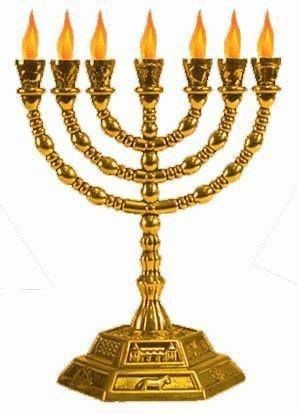
Image: Hanukkah is the Jews’ celebration of the temple dedication in Jerusalem in 165 or 164 BC.
Quote from https://snl.no/hanukka :
Hanukkah is a Jewish festival of lights that is celebrated for eight days in memory of the rededication of the temple in Jerusalem in the year 165 or 164 BC. In Norwegian, Hanukkah is therefore also called the temple dedication festival.
The holiday is not mentioned in the Old Testament and Tanakh and is not the most important religious holiday in Judaism, but it has great cultural significance for Jews all over the world. Lighting candles in the home every day for eight days is considered a religious duty (mitzvah). Many Jews observe this custom, even those who do not otherwise observe other Jewish customs. Since Hanukkah is celebrated at the same time as Christian Christmas, Hanukkah has become an important engagement for Jewish children. In many countries in the West, such as the United States, official celebrations of Hanukkah are now also held.
Introduction.
When Solomon became king, he had peace on all sides, but he left behind a poor foundation for peace. But Christ had greater wisdom and laid a good foundation for peace.
When Solomon became king after David, his father, he had peace on all sides and had the temple built. With that he could secure the kingdom for his heir and descendants, but despite his great wisdom he left behind a poor foundation for peace, the kingdom was divided, so his son took over power over less than half the kingdom.
When emperor Augustus came to power in the Roman Empire, there was a peaceful time, so people talked about starting a new era with him, but it came with the birth of Jesus and with good reason. He had greater wisdom than Solomon and laid the foundation for lasting peace, for God reconciled the world to himself by letting his Son, Jesus Christ, die on a cross instead of us. On that foundation we have peace with God. Jesus’ work of salvation was complete and perfect and the newborn Christian church was built on that foundation.
God loved the world so much that he sent his Son, the onlybegotten, so that whoever believes in him should not perish but have eternal life. To all who received him, he gave the right to become children of God, born of the water of life and the Spirit of God, and that which is born of the Spirit is spirit. Jesus is the bread of life, who came down as manna from heaven to give life to the world, the word that he has spoken to us is spirit and life (John 6:63). By believing that he rose from the dead, we become righteous before God, by confessing that he is Lord, we are saved. He was taken up to heaven and sat at the right hand of the Father and sent us the Holy Spirit. He gives us spirit and life from heaven and it is still only for us to receive by faith, he gives us himself as the bread of life, as it is symbolized in the Eucharist and it is just for us to receive by faith and live by it.
The desolating abomination. Hellenization?
In 167 BC King Antiochus IV Epiphanes set up the “destructive abomination” in Jerusalem and demanded that everyone in his kingdom should worship Zeus and the other Greek gods. In reaction to the democracy in Athens, Greek poetry had made Zeus even more sovereign, as the god of all gods, who ruled with a universal morality, so that everything that happened was the work of Zeus. Despite the fact that the gods in Greek mythology sprang from chaos! But it was their answered the jews´s God Almighty. Strange that poetry should gain such great power over people, now it was even demanded that those who did not worship this pantheon should be killed. Antiochus’ methods were corruption, lies and betrayal.
It was the Jews’ faith in the God of their fathers that made them take courage and fight against and manage to free themselves from this slavery. But this came upon them so suddenly that they were perplexed and made decisions that would apply until a new prophet, a true prophet, arose.
Daniel had prophesied about this long ago, but Malachi also prophesied about the messenger who would prepare the way for the Lord (Mal.3,1&4,5 Matt.11,10 Luke 1,17), but then it was as if they had forgotten the messages of both Joel and Malachi and as if they themselves had trampled down the courtyard and entrenched themselves in the city of David with their paganism, as the pagans had done before.
So Jesus prophesied about the desolating abomination that stands on holy ground, as if it were still there and said that whoever sees it, let him watch out for it. He also said that in the last days many will fall away and betray and hate one another. Then there is probably a religious/political power that is behind and sets up the desolating abomination, to try to gain power with it. Thus came the persecutions of Christianity, they were persecuted just as the Jews were persecuted a couple of hundred years earlier.
If we see any similar tendencies in our time, whether it is against Christians or Jews, we should pay attention to it.
The 70 weeks of years in Dan.9, sabbath year and year of release.
Peter asked Jesus how many times they should forgive, 70 times 7, he answered.
Matt 18,21 21 Then Peter came to him and said, “Lord, how many times must I forgive my brother who sins against me? As many as seven times?” 22 Jesus said to him, “Not seven times, I tell you, but seventy-seven times!
23 “For this reason, the kingdom of heaven is like a king whowanted to settle accounts with his slaves. 24 As he began settlinghis accounts, a man who owed 10,000 talents was brought to him. 25 Because he was not able to repay it, the lord ordered him to be sold, along with his wife, children, and whatever he possessed, andrepayment to be made. 26 Then the slave threw himself to the ground before him, saying, ‘Be patient with me, and I will repay youeverything.’ 27 The lord had compassion on that slave and releasedhim, and forgave him the debt. 28 After he went out, that same slavefound one of his fellow slaves who owed him 100 silver coins. So he grabbed him by the throat and started to choke him, saying, ‘Pay back what you owe me!’ 29 Then his fellow slave threw himself down and begged him, ‘Be patient with me, and I will repay you.’ 30But he refused. Instead, he went out and threw him in prison untilhe repaid the debt. 31 When his fellow slaves saw what had happened, they were very upset and went and told their lordeverything that had taken place. 32 Then his lord called the first slave and said to him, ‘Evil slave! I forgave you all that debt becauseyou begged me! 33 Should you not have shown mercy to your fellow slave, just as I showed it to you?’ 34 And in anger his lord turnedhim over to the prison guards to torture him until he repaid all he owed. 35 So also my heavenly Father will do to you, if each of you does not forgive your brother from your heart.”
God rested on the seventh day from all his work and sanctified it, so that we may keep the Sabbath holy. Therefore, the number seven is considered a sacred number. But why did he answer 70 times seven? It probably refers to the 70 weeks of years in Dan.9. The prophet Jeremiah had prophesied that 70 years would pass before they would be able to return to their land, the year approached and Daniel entered into prayer and fasting for three weeks. But Isaiah had prophesied that they would be able to return by the Persian king Cyrus and it had already happened. Jerusalem fell in 586 BC, 70 years later would be in 516, but the new temple was consecrated already in 515 BC.
Quotation from https://snl.no/tempelet_i_jerusalem :
After the Persian king Cyrus II conquered Babylon in 539 BC, both the Jews and other abducted population groups were allowed to return to their homelands. The Jews are also said to have received the stolen cult objects from the first temple back (Ezra chapter 1, verses 7–11). According to the Bible texts, administrators were also sent to organize the reconstruction of both the city of Jerusalem and its temple. The new temple was consecrated around 515 BC. In Jewish tradition, this is called the Second Temple.
But when Daniel prayed like this, the angel Gabriel came and answered him, 70 weeks would pass for the city and the people, then we must understand it as weeks of years, sabbatical years. A sabbatical year is the seventh year, then they should let the land lie fallow. If someone had become a debt slave, so they were driven from their farm and land, had to sell the land, so they became slaves, then they should still be able to return to their land after seven sabbatical years, 49 years in other words. This was the law of the land. In 70 sabbatical years this would happen ten times in other words. It would take 490 years. God had threatened them that if they fell away from him, they would be taken away from their land, so it would have to take back its sabbatical years.
After a 7 sabbatical year there would arise one who was anointed, it would have to be Cyrus. Jerusalem fell in 587 BC, 49 years later would then be in 538, so that fits well. The last week of years would be difficult, we count 69 sabbatical years, 483 years from 586, we come to 103 BC. The next sabbatical year would be in 94 BC. Then it would be the tenth year of release.
Dan.9, 22 He spoke with me, instructing me as follows: “Daniel, I have now come to impart understanding to you. 23 At the beginning of your requests a message went out, and Ihave come to convey it to you, for you are of great value in God’s sight. Therefore consider the message and understand the vision:
24 “Seventy weeks have been determined
concerning your people and your holy city
to put an end to rebellion,
to bring sin to completion,
to atone for iniquity,
to bring in perpetual righteousness,
to seal up the prophetic vision,
and to anoint a Most Holy Place.
25 So know and understand:
From the issuing of the command to restore and rebuild
Jerusalem until an anointed one, a prince arrives,
there will be a period of seven weeks and sixty-two weeks.
It will again be built, with plaza and moat,
but in distressful times.
26 Now after the sixty-two weeks,
an anointed one will be cut off and have nothing.
As for the city and the sanctuary,
the people of the coming prince will destroy them.
But his end will come speedily like a flood.
Until the end of the war that has been decreed
there will be destruction.
27 He will confirm a covenant with many for one week.
But in the middle of that week
he will bring sacrifices and offerings to a halt.
On the wing of abominations will come one who destroys,
until the decreed end is poured out on the one who destroys.”
How does this fit with history? Quotation from quote from https://snl.no/det_gamle_israel :
Alexander Janneus (Jannai) (103–76 BCE) was the first to appoint himself king, and who ruled over an area that included all of Palestine from the Mediterranean in the west to the highlands east of the Jordan River, from the Golan in the north to Edom in the south. After his death, his wife, Salome Alexandra (139–67 BCE), took over as reigning queen. Her reign is considered the last peaceful time in the country.
Quotation from https://snl.no/aleksander_janneus :
Alexander Janneus was king of Judea and high priest. He ruled approximately 103–76 BCE. Alexander was the son of Johanan Hyrcanus and, like his predecessors of the Maccabee dynasty, was concerned with expanding the country’s borders. According to the Jewish historian Josephus Flavius, Alexander Janneus conquered the entire coastal area from Dor (today’s Caesaria) to Gaza, as well as parts of the Negev Desert and large parts of Moab. In the north, he incorporated both the Golan Heights and Gilead, as well as the area on the east side of the Jordan River. Several attacks from neighboring countries were averted
In religious matters, Alexander Janneus collaborated with the Sadducees, while the Pharisees were opposed and forced out of leading positions. His ruthless behavior and his openness to Hellenistic influence led to strong opposition from both the people and the Pharisaic rabbis. According to Josephus, Alexander was directly bullied by his opponents during the celebration of the Feast of Tabernacles (Sukkot). They are said to have bombarded him with small citrus fruits, etrogim. The opposition led to a civil war, where both parties sought help from outsiders.
Towards the end of his life, Alexander Jannaeus entered into several agreements with the Pharisees, but only under his widow and later queen Salome Alexandra, did the Pharisees regain their power, and the country experienced a period of peace.
END OF QUOTE.
Many criticized them for not being of the right priestly lineage, others believed that they could not be high priests at the same time as having royal power. No, this was in conflict with Ezekiel.46 and what about Malachi’s criticism of the priestly service in Mal.2? This only got worse. How could they be anointed? No, this was probably so secularized that neither priest nor king was anointed, it was as if the “anointed one will be cut off and have nothing”. It became clear when they later rejected Christ, God’s anointed one.
Quotation from https://snl.no/saddukeerne :
The Sadducees were a Jewish religious political party in Judea from the 2nd century BCE to the 1st century CE.
The name is probably derived from Zadok (Zadok), who according to several texts in the Old Testament and Tanakh was a priest during the time of King David (2 Samuel 19:11 and 1 Chronicles 15:11).
According to tradition, male descendants of Zadok are said to have served as high priests until the Jewish revolt against the Seleucids, the country’s Greek/Syrian rulers. The fighting began in 167 BCE and was led by Judah Maccabee and his brothers. The family was Hasmonean, the name of a Jewish priestly family. (Maccabees is a nickname meaning “hammer”.) The Jews’ claim led to this family taking over power in the country. In 152 BCE, Jonathan the Maccabee had himself appointed high priest, and this office was later inherited in the family. The family then had both secular and religious power, which had not been the case previously. This met with much opposition. Several groups, including the Pharisees, believed that the Hasmoneans had no right to the high priesthood because they were not counted as descendants of Zadok. Others believed that they could not be both high priests and have kingly power.
A year of grace with the release of prisoners; a year of liberation!
Isaiah prophesied that one would come who was anointed by the Holy Spirit and proclaim a year of grace with the release of prisoners, a year of liberation, that is.
Isaiah 61:1 The Spirit of the Sovereign Lord is upon me,
because the Lord has chosen me.
He has commissioned me to encourage the poor,
to help the brokenhearted,
to decree the release of captives
and the freeing of prisoners,
2 to announce the year when the Lord will show his favor,
the day when our God will seek vengeance,
to console all who mourn,
3 to strengthen those who mourn in Zion
by giving them a turban, instead of ashes,
oil symbolizing joy, instead of mourning,
a garment symbolizing praise, instead of discouragement.
They will be called oaks of righteousness,
trees planted by the Lord to reveal his splendor.
4 They will rebuild the perpetual ruins
and restore the places that were desolate;
they will reestablish the ruined cities,
the places that have been desolate since ancient times.
Jesus even read halfway through verse 2, stopped before anything was written about punishment and then he said that now this had happend. The Pharisees and the scribes looked at him, they were probably waiting for the continuation, but then he said something they did not like.
Luke. 4: 14 Then Jesus, in the power of the Spirit, returned to Galilee, andnews about him spread throughout the surrounding countryside.15 He began to teach in their synagogues and was praised by all.
16 Now Jesus came to Nazareth, where he had been brought up, andwent into the synagogue on the Sabbath day, as was his custom. Hestood up to read, 17 and the scroll of the prophet Isaiah was given to him. He unrolled the scroll and found the place where it waswritten,
18 “The Spirit of the Lord is upon me,
because he has anointed me to proclaim good news to the poor.
He has sent me to proclaim release to the captives
and the regaining of sight to the blind,
to set free those who are oppressed,
19 to proclaim the year of the Lord’s favor.”
20 Then he rolled up the scroll, gave it back to the attendant, and sat down. The eyes of everyone in the synagogue were fixed on him. 21Then he began to tell them, “Today this scripture has been fulfilledeven as you heard it being read.” 22 All were speaking well of him, and were amazed at the gracious words coming out of his mouth. They said, “Isn’t this Joseph’s son?” 23 Jesus said to them, “No doubtyou will quote to me the proverb, ‘Physician, heal yourself!’ and say, ‘What we have heard that you did in Capernaum, do here in yourhometown too.’” 24 And he added, “I tell you the truth, no prophet isacceptable in his hometown. 25 But in truth I tell you, there weremany widows in Israel in Elijah’s days, when the sky was shut upthree and a half years and there was a great famine over all the land. 26 Yet Elijah was sent to none of them, but only to a womanwho was a widow at Zarephath in Sidon. 27 And there were manylepers in Israel in the time of the prophet Elisha, yet none of themwas cleansed except Naaman the Syrian.” 28 When they heard this, all the people in the synagogue were filled with rage. 29 They got up, forced him out of the town, and brought him to the brow of the hillon which their town was built, so that they could throw him downthe cliff. 30 But he passed through the crowd and went on his way.
From peaceful agricultural land to tyranny. Or can democracy bring justice and lasting peace?
Israel.
The people of Israel conquered the promised land and found peace and rest, it was an agricultural land, their only “state administration” was the priesthood and their sanctuary was a tent. It was not surprising then that foreigners came into their land and displaced them, but then God told them that it was because they had turned away from him, so it was their fault. So they had to humble themselves before him and ask him for mercy and help, then he raised up a judge who led them in the fight against the enemy. That is why this is called the time of the judges.
But then they wanted a king, like the other peoples and God gave them such a king as they wanted and let the prophet Samuel anoint Saul as king. But it was a failure, for he broke God’s Word. Then God wanted to give them a king after his own heart and let Samuel anoint David as king, while he was a young shepherd boy. After some time David had to flee from Saul with a small army, because Saul wanted to kill him. David could have killed him twice, but spared his life, because he did not want to kill “the one whom God had anointed”, despite the fact that Saul had actually lost his anointing. It happened that Saul lost to the enemy and David became king instead, by peaceful means, without there being a real civil war. He had the anointing, the people knew it and therefore they turned to him.
David had to constantly humble himself before God and ask for grace and help, so he saw himself as poor and helpless, so he had to take refuge to the Lord, he also prayed for others who came into similar situations and he also became a model of Messiah, in this way he spoke prophetically about the Messiah. We also see this in Solomon (Psalm 72).
When David came to power, he got enmity from the neighboring peoples, but experienced that God was with him and gave him advice and strength then too, so he defeated them and became a powerful king. When Solomon took power, he had peace on all sides, then he was commissioned to build the temple in Jerusalem. The temple was decorated with gold inside, so it was like a treasury. He was wise and became rich by being king, rumors spread about his wisdom and wealth all the way to Ethiopia. He became rich, as if there was no difference between his personal property and the treasury of the state. He engaged in trade and shipping.
However, he did not leave behind a good foundation for peace, the kingdom was divided, his son, Rehoboam, received less than half, the southern kingdom of Judah, with Jerusalem as its capital. Jeroboam became king of the northern kingdom and quickly turned away from the Lord. In Judah, there were alternation between godly and wicked kings, God was gracious and forgiving, but King Manasseh was a wicked tyrant who killed many people in Jerusalem, the Lord wouldn´t forgive that, therefore Jerusalem would also fall to the Babylonians and the people were abducted. Manasseh was the son of Hezekiah and he was a godly king. But great injustice had already been done in the country, contrary to David’s policy, great people did injustice to small people.
Mica.1,1 This is the Lord’s message that came to Micah of Moreshethduring the time of Jotham, Ahaz, and Hezekiah, kings of Judah, which he saw concerning Samaria and Jerusalem.
Micah.2,1 Beware wicked schemers,
those who devise calamity as they lie in bed.
As soon as morning dawns they carry out their plans,
because they have the power to do so.
2 They confiscate the fields they desire
and seize the houses they want.
They defraud people of their homes
and deprive people of the land they have inherited.
3 Therefore the Lord says this:
“Look, I am devising disaster for this nation!
It will be like a yoke from which you cannot free your neck.
You will no longer walk proudly,
for it will be a time of catastrophe.
4 In that day people will sing this taunt song to you—
they will mock you with this lament:
‘We are completely destroyed;
they sell off the property of my people.
How they remove it from me!
They assign our fields to the conqueror.’”
5 Therefore no one will assign you land in the Lord’s community.
6 “Don’t preach with such impassioned rhetoric,” they say excitedly.
“These prophets should not preach of such things;
we will not be overtaken by humiliation.”
7 Does the family of Jacob say,
“The Lord’s patience can’t be exhausted—
he would never do such things”?
To be sure, my commands bring a reward
for those who obey them,
8 but you rise up as an enemy against my people.
You steal a robe from a friend,
from those who pass by peacefully as if returning from a war.
9 You wrongly evict widows among my people from their cherished homes.
You defraud their children of their prized inheritance.
10 But you are the ones who will be forced to leave!
For this land is not secure;
sin will thoroughly destroy it!
11 If a lying windbag should come and say,
‘I’ll promise you blessings of wine and beer,’
he would be just the right preacher for these people!
12 “I will certainly gather all of you, O Jacob,
I will certainly assemble those Israelites who remain.
I will bring them together like sheep in a fold,
like a flock in the middle of a pasture;
they will be so numerous that they will make a lot of noise.
13 The one who can break through barriers will lead them out;
they will break out, pass through the gate, and leave.
Their king will advance before them;
the Lord himself will lead them.”
(https://netbible.org/bible/Micah+2, the bible-quotationa are from this site).
………
We see that this also ended with a Messianic prophecy.
Greece.
Jeremiah had prophesied that they would be allowed to return in 70 years and when the time approached, Daniel fasted and prayed for three weeks. Then the Lord came to him and said that he had resisted the Persians for three weeks, but then Michael, one of the foremost chieftains, came and helped him. That is why he had time to come and give him an answer, that is. Who was this Michael? The time corresponds to the beginning of nature-philosophy in Greece, with Thales. He was not a military leader but a peaceful and poor mathematician and nature-philosopher. This understanding of reality was essential for later to rise a limited democracy in Greece.
The development in Greece went in a similar way to that in Israel, it started as an old-fashioned agricultural society, then it became a more modern society with limited democracy, crafts, trade and shipping, then there was a reaction.
Sparta was, like Macedonia, an old-fashioned, aristocratic, agricultural society, otherwise Greece was a more modern society with trade, shipping, crafts and a limited democracy and then Athens became dominant in this. There was great opposition between Athens and Sparta and the Peloponnesian War started when Sparta attacked Athens in 431 BC and they won in 404 BC. Then Philip of Macedonia came and took over power in Greece, he had a plan and his son, Alexander the Great carried it out by going to war against Persia. Greece was allowed to have local democracy, he also was tolerant of the people in the land he conquered, to avoid rebellion.
The Roman Empire.
Friendship between Israel and the Roman republic.
But in the Seleucid Empire, Antiochus IV Epiphanes managed to make a coup, his methods were corruption, lies and betrayal, and then he demanded dictatorial power, by demanding that everyone should worship Zeus and the other Greek gods. Here the prophecy in Dan.10 applies that King Michael helps the Lord in the fight against both the Persian Empire and Greece.
Dan.10,19 O Lord, hear! O Lord, forgive! O Lord, pay attention, and act! Don’t delay, for your own sake, O my God! For your city and your people that belong to you.”
20 While I was still speaking and praying, confessing my sin and the sin of my people Israel and presenting my request before the Lordmy God concerning his holy mountain
The Maccabeans made a peace and friendship agreement with the Roman Empire, so here it seems that it would be the great king Michael that Daniel prophesied about in Dan.12, they could expect him to emerge as the king of the Roman Empire. The Roman Empire was on the rise and their friendship agreement was respected by other nations. And then they made a friendship agreement with Sparta in Greece, since they descended from the Jews.
At this time there was a limited democracy at the top level in Rome, they should represent the people for their best, a democratic way of thinking, even if it was not formal, with the right to vote. Quotation from 1.Macc.8, https://bible.usccb.org/bible/1maccabees/8 :
When the Greeks planned to come and destroy them,
10the Romans discovered it, and sent against the Greeks a single general who made war on them. Many were wounded and fell, and the Romans took their wives and children captive. They plundered them, took possession of their land, tore down their strongholds and reduced them to slavery even to this day.
11All the other kingdoms and islands that had ever opposed them they destroyed and enslaved; with their friends, however, and those who relied on them, they maintained friendship.
12They subjugated kings both near and far, and all who heard of their fame were afraid of them.
13Those whom they wish to help and to make kings, they make kings; and those whom they wish, they depose; and they were greatly exalted.
14Yet with all this, none of them put on a diadem or wore purple as a display of grandeur.
15But they made for themselves a senate chamber, and every day three hundred and twenty men took counsel, deliberating on all that concerned the people and their well-being.
16They entrust their government to one man* every year, to rule over their entire land, and they all obey that one, and there is no envy or jealousy among them.
END OF QUOTATION.
How the roman republic came to be.
Rome also started as an agricultural community, around the mouth of the Tiber. There were some mounds that were easy to defend, so the villages joined together to form a defense alliance that became Rome. The Latins pressed in from the south and the Etruscans from the north, around 600 BC the Etruscans took power, but in 509 they managed to free themselves. The kingdom was abolished and they got a republic with two consuls, elected for a year at a time. They shared power with the plebeian parliament and the senate. The plebeian parliament elected officials, including the consuls, who had the right to approve or reject bills, but not the right to propose bills (law-proposals).
The patricians (aristocrats) had most power, as long as they sat in the senate and could be officials. They had power in the plebeian parliament as well, because the right to vote was graded according to property. The plebeians (common people) were practically lawless, because there were no written laws and it was the patricians who judged. But in the fight against external enemies the patricians had to rely on the plebeians. They threatened to move from the city, thus forcing one rght after another. The first great victory was the office of tribune of the people. The tribune of the people could veto bills. Then they demanded that the laws be written down. The Senate was a council of former officials, but now the plebeians also had access. In this way, the class struggle was moderated and it became important as an internal driving force in the rise of the Roman Empire. Around the middle of the 4th century BC, the plebeians had the same political rights as the patricians.
The class struggle.
Quote from
Patricians and plebeians
In the early republic, there was a sharp distinction between two population groups or estates in Rome: the patricians (patricii), who constituted the first estate, a kind of early Roman nobility, and the plebeians (plebeii or plebs), who constituted the rest of the citizens. We do not know what the difference originally came from, but the name patricians is related to patres, fathers, and is associated with the heads of families who had seats in the king’s council (the senate).
The traditional story tells that Romulus appointed 100 family heads to sit on his council. At the beginning of the republic, the patricians dominated both economically and politically. The entire early republic is thus characterized by the so-called struggles of the estates, with a gradual acceptance to the demands of the plebeians: abolition of debt slavery, access to political offices and to the priesthood, political participation, equality before the law and the right to marry. The plebeians early established their own assemblies and their own ombudsmen to protect themselves (tribunes of the people). These were inviolable and could appeal to higher officials to protect the common people. Gradually, the plebeians gained prominence and gained greater legal certainty, the right to marry and political rights on par with the patricians, although certain status differences were always maintained, and some priestly roles were reserved for the patricians. The dispute was first settled in 287 BCE, when the Romans passed a law (lex Hortensia) that recognized the decisions of the plebeian assembly (plebei scita) as legally valid. Compared to the plebeians, the patricians were extremely few in number and their power gradually eroded. By the beginning of the imperial period, many families had died out.
Patricians also traditionally acted as protectors (patrons) for plebeians who were thereby their clients. The relationship involved mutual obligations and benefits. The patron received prestige and hospitality, political and military support; the client protection in court and help in other ways. Clientelism was in earlier times formalized and hereditary; it could later be looser and more opportunistic, but always continued to be a strong pattern in Roman society and an important factor in Roman politics.
Class differences (as between patricians and plebeians) and loyalty ties between high and low (as between patrons and clients) cut across economic and social stratifications and had a conservative effect on the social order.
END OF QUOTE.
Southern Italy was a poor agricultural country, the nobles worked the fields themselves. But the Greek cities (colonies) in southern Italy had engaged in profitable trade with the Mediterranean countries. When the Romans conquered southern Italy, they took over this trade, and an upper class of wealthy merchants emerged, alongside the landowning nobility. Then there was a possibility of a similar conflict between these two upper classes, as had been the case in Greece?
Phoenicians had founded Carthage and the Punic Wars were three long wars between Rome and Carthage, until Carthage was razed to the ground in 146 BC. In the Second Punic War, the armies of Hannibal of Carthage had ravaged southern Italy, so the farms were left deserted and the free peasantry was displaced by rich landowners who could run the farms with tenants or slaves. Formerly free peasants came to Rome as unemployed proletarians, then the government started to give then grain.
The governors collected taxes, but were so corrupt that they made themselves rich in a year. All this made the class difference grow wider and it became a matter for the tribune of the people. Tiberius Graccus became tribune of the people in 133 BC, he was influenced by the Greek ideas of freedom and democracy. He wanted to bring the unemployed proletarians back to the land and establish an independent peasantry. He had an old law revived that a single man could only have a certain amount of state land, if someone had more, the state would take back what was left and divide it into small farms for the poor. It was met with much opposition, but was carried out anyway. Tiberius ran for re-election, which was against the law, then there was fighting in the streets and he and 300 supporters were killed.
Civil war, from republic to empire.
In 123, his brother Gaius Gracchus became tribune of the people, so the reform plans continued, despite opposition from the Senate. He then tried to become tribune of the people in 121, but then a bounty was put out to kill him, so he took his own life. 2-300 of his friends were killed and then 3000 were executed without law or trial. The best reforms of Gaius were reversed, the land distribution stopped. But now the folks party had learned, in the fight against the senate party, violence must be met with violence. Thus began the civil wars. The Senate party won under the general Sullet, thus the Senate regained its old power, the parliament and the tribune of the people gained less power.
Marius was a skilled general and he let proletarians become mercenaries in his army, they swore allegiance to the general instead of Rome, then they could more easily become a tool for him, against the state, if he wanted to.
Caesar believed that the Senate was not able to govern the great empire, the constant change of officials was dangerous, a thorough reorganization under strong leadership was needed and he believed he was the right person for that task, but for the time being he had to share power with Pompey. They got their provinces, Caesar got Gaul and Pompey got Spain. Pompey did not travel to his province, but stayed in Rome, there he joined the Senate and they feared the great power of Caesar, because he had won his wars.
Then Caesar applied to become consul in 49 BC. Then the Senate demanded that he disband his army, which he agreed to do, if Pompey did the same, but they only gave him a deadline to disband the army. Then Caesar decided to cross the Rubicon, into Pompey’s territory, and he won the war, so in 45 BC Caesar could go to Rome as sole ruler.
Caesar ruled the Roman Empire as dictator, he tried to reconcile old contradictions, but got nowhere with the most committed republicans. It became clear that Caesar wanted royal power, so the republicans hatched a conspiracy and in 144 BC he was assassinated in the Senate in Rome. But it did not go as the republicans had planned, because the Senate did not fulfill its task. In the confusion that followed, Antony and Octavian took power. Antony was one of the consuls that year and Octavian was a relative and heir to Caesar. After a couple of years of civil war, the republicans were defeated. Octavian gained power in the west and Antony gained power in the east.
Antony ruled mostly as an absolute Eastern king with capitals in Alexandria and Antioch. The Senate looked with displeasure at his way of governing and that he married the Egyptian queen Cleopatra. So they deposed him and Octavian came against him with a large army and fleet and defeated him in the naval battle of Actium (31 BC). He then took the slogan “revival of the republic” and tried to revive the old religion and create a new aristocracy. He proclaimed himself Emperor Augustus and was to be the supreme leader of the religion, which became emperor worship.
The Senate and the Diet held their meetings as before, the old civil service remained in place, but Augustus let himself be elected for life to the most important offices. As imperator (general), he was given supreme power over the army, as proconsul he ruled over the most important provinces, as tribune of the people he was sacred and inviolable, as pontifex maximus he was the supreme leader of religion. He did not emerge as a despot, but as princeps, the foremost man in the state. With wise politics he managed to reconcile the republican opposition that still existed.
Thus the Roman Empire became an empire, the emperor was the supreme leader of religion and it became emperor worship.

 Faith and Entropy