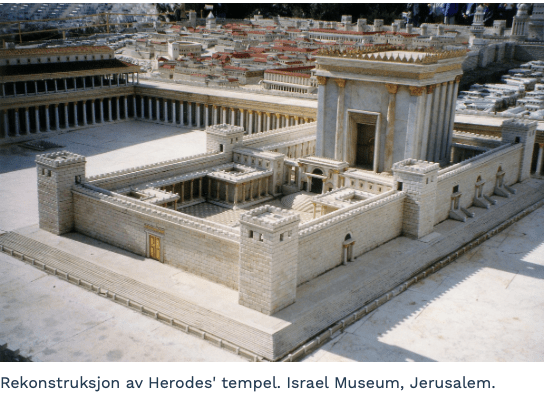
Picture: The second temple, the temple of Cyrus and Zerubbabel, also called “Herod’s temple.” Solomon’s temple and its walls were demolished when the Babylonians burned and destroyed the city in 587 f.Kr. But the new temple that was built later was smaller, this was something that they did not control, it was the Persian king Cyrus who was behind this and later Herod the Great was behind a rebuilding, so it was called Herod’s temple.
Worse, they did not stick to what Ezekiel said about the priestly ministry and did not obey what Malachi later said about it.
Introduction
The hope of the glory of God, doesn´t put us in shame.
God has created all things and has a different kind of existence than the physical nature He has created, it is perishable, but He Himself is spirit and is eternal and omnipotent, He is in His eternal heaven and His kingdom is eternal. We are dust and cannot come to Him unless He comes to us. Yet he said to his people that if they sought him with all their hearts, they would find him. His arm was not too short to save them, but their sins separated them from Him.
But Jesus was the Lamb of God, who bore the worlds sin, he offered himself as a sin sacrifice who was slaughtered to atone for the world’s sin, that single sacrifice took away the world’s sin once and for all. On that basis, we are allowed to enter into fellowship with God again. Christ is the Son of God, the Messiah of God, who has sat down by God in heaven and his arms are still not too short to save.
We have no way of saving ourselves, salvation is a gift and we can only receive it as a gift God gives us from heaven. He loved the world so much that he sent his only Son, so that whoever believes in him will not perish but have everlasting life. To all who received him, he gave the right to become the children of God, born of the water of life and the Spirit of God, and what is born of the Spirit is spirit. Jesus is the bread of life who came down from heaven to give life to the world, the word he has spoken to us is spirit and life.
God reconciled the world to Himself before we knew it, then it was preached to us, giving us hope of God’s glory, and that hope does not put us to shame.
Romans 5:1 Therefore being justified by faith, we have peace with God through our Lord Jesus Christ:
2 By whom also we have access by faith into this grace wherein we stand, and rejoice in hope of the glory of God.
3 And not only so, but we glory in tribulations also: knowing that tribulation worketh patience;
4 And patience, experience; and experience, hope:
5 And hope maketh not ashamed; because the love of God is shed abroad in our hearts by the Holy Ghost which is given unto us.
6 For when we were yet without strength, in due time Christ died for the ungodly.
7 For scarcely for a righteous man will one die: yet peradventure for a good man some would even dare to die.
8 But God commendeth his love toward us, in that, while we were yet sinners, Christ died for us.
9 Much more then, being now justified by his blood, we shall be saved from wrath through him.
10 For if, when we were enemies, we were reconciled to God by the death of his Son, much more, being reconciled, we shall be saved by his life.
11 And not only so, but we also joy in God through our Lord Jesus Christ, by whom we have now received the atonement.
2 Cor.3:12 Seeing then that we have such hope, we use great plainness of speech:
13 And not as Moses, which put a vail over his face, that the children of Israel could not stedfastly look to the end of that which is abolished:
14 But their minds were blinded: for until this day remaineth the same vail untaken away in the reading of the old testament; which vail is done away in Christ.
15 But even unto this day, when Moses is read, the vail is upon their heart.
16 Nevertheless when it shall turn to the Lord, the vail shall be taken away.
17 Now the Lord is that Spirit: and where the Spirit of the Lord is, there is liberty.
18 But we all, with open face beholding as in a glass the glory of the Lord, are changed into the same image from glory to glory, even as by the Spirit of the LORD.
Replacement theology?
Replacement theology is that the Christian Church replaces Judaism, but it is a question of definition, because what is really Judaism and what is really the Christian Church. It is both Abraham’s faith, he believed God and it was counted to him as righteousness. He promised him that in his ancestry all nations would be blessed, those who blessed him would be blessed, but those who cursed him would be cursed. This promise is fulfilled in Christ.
Abraham demonstrated his faith by showing that he was willing to sacrifice his Son, Isaac, to God, thus showing that he believed that God could raise him from the dead. But he got to sacrifice a lamb instead. This serves as a prophecy of God loving the world so much that He sent His only Son, so that whoever believes in Him will not perish but have everlasting life. To all who received him, he gave the right to become God’s children. God reconciled the world to himself, by letting his Son die on the cross, to atone for all the world’s sin. By believing that He rose from the dead, we become righteous before God and by acknowledging that He is Lord, we are saved. This good news will be preached to all nations.
I have written about this here: https://faith-and-entropy.com/2025/08/13/ny-tid-63-endetidssyn-38-trua-og-vona-draumen-og-visjonen-gud-gav-oss-gud-gjer-nokon-nytt-han-set-det-i-verk-medan-vi-framleis-er-i-denne-verda-20-det-var-fred-i-salomos-regjeringstid-men-han-2/
From David to Solomon.
David was a man after God’s heart, so God allows the prophet Samuel to annoint him as king over the people of Israel and it was a success, he became a great and powerful king. Nevertheless, he fell into sin when he committed adultery with Bathsheba and betrayed her husband, so that he fell in the war. The prophet Nathan rebuked him, so that he confessed his sin to God, humbled himself, and begged for mercy and forgiveness, so that he did not have to die for his sin. Nevertheless, he was punished, because there was strife in his house, the eldest son, Absalom, rebelled and wanted to take over the power, so he had to flee. David won the battle that followed, but Absalom was killed. Bathsheba became David’s wife and then he had a son Solomon with her, and it was he who should take over the kingship when the time came. In his old age, David was no longer with the army in battle, he got a beautiful young girl, Abisjag, as a maid, she was supposed to keep him warm with the night as well, but not as a whore, that is.
The second eldest son, Adonijah, tried to proclaim himself king, but then David had the prophet Nathan anoint Saalomo as king and Adonijah had to humble himself before Solomon. Later, Adonijah asked for Abisjag to be his wife, but Solomon understood it as an attempted coup and sent the commander to kill him (1 Kings 2).
Solomon was young when he took over a great kingdom, but he found peace on all sides, he was going to build the temple. God wanted to be his father and gave him great wisdom and made him rich, so that it was rumored about him all the way to Ethiopia. With this, especially with the temple, he was able to secure the kingdom for the heir and descendants.
Solomon praised God’s Messiah, in comparison with David.
Psalm 72:1 Give the king thy judgments, O God, and thy righteousness unto the king’s son.
2 He shall judge thy people with righteousness, and thy poor with judgment.
3 The mountains shall bring peace to the people, and the little hills, by righteousness.
4 He shall judge the poor of the people, he shall save the children of the needy, and shall break in pieces the oppressor.
5 They shall fear thee as long as the sun and moon endure, throughout all generations.
6 He shall come down like rain upon the mown grass: as showers that water the earth.
7 In his days shall the righteous flourish; and abundance of peace so long as the moon endureth.
8 He shall have dominion also from sea to sea, and from the river unto the ends of the earth.
9 They that dwell in the wilderness shall bow before him; and his enemies shall lick the dust.
10 The kings of Tarshish and of the isles shall bring presents: the kings of Sheba and Seba shall offer gifts.
11 Yea, all kings shall fall down before him: all nations shall serve him.
12 For he shall deliver the needy when he crieth; the poor also, and him that hath no helper.
13 He shall spare the poor and needy, and shall save the souls of the needy.
14 He shall redeem their soul from deceit and violence: and precious shall their blood be in his sight.
15 And he shall live, and to him shall be given of the gold of Sheba: prayer also shall be made for him continually; and daily shall he be praised.
16 There shall be an handful of corn in the earth upon the top of the mountains; the fruit thereof shall shake like Lebanon: and they of the city shall flourish like grass of the earth.
17 His name shall endure for ever: his name shall be continued as long as the sun: and men shall be blessed in him: all nations shall call him blessed.
18 Blessed be the LORD God, the God of Israel, who only doeth wondrous things.
19 And blessed be his glorious name for ever: and let the whole earth be filled with his glory; Amen, and Amen.
20 The prayers of David the son of Jesse are ended.
But despite his great wisdom, he leaves behind a poor foundation for peace, the kingdom was divided, so his son was allowed to take power over less than half of the kingdom.
I have written about this here:
How could God’s covenant with Levi and David stand?
They lived in the old covenant, actually there were several covenants and here it becomes a question of how God’s covenant with Levi and David can stand.
Jer.33:14 Behold, the days are coming, saith the word of the Lord, when I fulfill the good promise I made to Israel and Judah. 15 In those days, when the time comes, I will cause a righteous flow to grow up in the seed of David. He will do justice and justice in the land. 16 In those days Judah will be saved, and Jerusalem will dwell in safety. And this is the name the city will have: “The Lord our righteousness”. 17 For thus says the Lord, “It shall never desire a man of the seed of David to sit on the throne of Israel. 18 Neither will there be men among the Levite priests who can serve me, and who can offer burnt offerings at all times, burn grain offerings, and prepare sacrifices.
19 The word of the Lord came to Jeremiah, saying, 20 “Thus says the Lord, ‘If you can break my covenant with day and night, so that day and night do not come at the right time, 21 then my covenant with David my servant will also be broken, so that he will have no son to sit on his throne, and the same covenant with the Levite priests who serve me. 22 After the comarahs after David my servant, and after the Levites who serve me, I will multiply as the army of heaven, which cannot be numbered, and the sand by the sea, which cannot be measured.
23 The word of the Lord came to Jeremiah, saying, 24 Have you not noticed what this people says: “The two seedes that the Lord chose he has cast out?” Thus they dishonor my people, because they no longer hold them to be a people.
25 Thus says the Lord, “If I have not made a covenant with day and night, and have not made laws for heaven and earth, 26 I will cast off the seed of Jacob and of David my servant, and will not take any of his comars to rule over the seed of Abraham, Isaac, and Jacob. But I will turn their fate and have mercy on them.
I have written about this here: https://faith-and-entropy.com/2025/08/24/ny-tid-67-endetidssyn-42-trua-og-vona-draumen-og-visjonen-gud-gav-oss-gud-gjer-nokon-nytt-han-set-det-i-verk-medan-vi-framleis-er-i-denne-verda-24-det-var-fred-i-salomos-regjeringstid-men-han/
In Zech.3 we see that the Levitical priestly ministry became a model for the priestly ministry in the new covenant, in Zech.4 we see it applied to the ministry as a builder, to build the temple as well, we meet this again in John Revelation.11.
Ezekiel criticized the kings of Judah who had been before the exile, but after they returned from exile, Malachi criticized the priests.
Mal.2:4 Then you will know that it is I
who sent you this message,
that my covenant with Levi may stand,
says the Lord of hosts.
5 My covenant with him gave life and peace,
And I gave him that so he could be eighted.
He feared me, and had age for my name.
6 Reliable guidance was in his mouth,
And there was no betrayal on his lips.
He walks with me in peace and righteousness
and saved many from the guilt of sin.
7 For a priest’s lips keep knowledge,
From his mouth people will ask for guidance,
for he is a messenger of the Lord of hosts.
8 But you have departed from the way
and caused many to fall
with the guidance you have given.
You have broken the covenant of Levi,
says the Lord of hosts.
I have written about this here:
Jesus came to fulfill the law and the prophets, and this applied to the prophecies both about the priesthood and the king’s work. He has made us a royal priesthood (2 Pet.2:1-9), but Ezekiel makes it clear to us that the ministry of the king is a completely different service from the ministry of the priesthood, so how are we to understand it?
Prophecy and history of the construction of the Second Temple.
But the new temple that they built when they returned from exile did not resemble Solomon’s temple, it was small compared to it. According to Biblex, Haggai’s prophecies came in 520, for a period of four months, Zechariah’s prophecies came in 520-518 BC, Zerubbabel was the grandson of King Jehoiachin and was among the first to return after the exile, they began to build on the temple as early as 538 BC. They faced opposition, so the work came to a halt, but 16 years after Cyrus let them go home, Haggai and Zechariah began to encourage them to start building again, and the temple was completed in BC.
Ezra 4:1 When the enemies of Judah and Benjamin learned that the former exiles were building a temple for the Lord God of Israel, 2 they came to Zerubbabel and the leaders and said to them, “Let us help you build, forlike you we seek your God and we have been sacrificing to him from the time of King Esarhaddon of Assyria, who brought us here.” 3 But Zerubbabel, Jeshua, and the rest of the leaders of Israel said to them, “You have no right to help us build the temple of our God. We will build it by ourselves for the Lord God of Israel, just asKing Cyrus, the king of Persia, has commanded us.” 4 Then the local people began to discourage the peopleof Judah and to dishearten them from building. 5 They were hiring advisers to oppose them, so as to frustrate their plans, throughout the time of King Cyrus of Persia until the reign of King Darius of Persia.
Ezra 5:1 Then the prophets Haggai and Zechariah son of Iddo prophesied concerning the Jews who were in Judahand Jerusalem in the name of the God of Israel who was over them.
Ezra 6:1 So Darius the king issued orders, and they searched in the archives of the treasury which were depositedthere in Babylon. 2 A scroll was found in the citadel of Ecbatana which is in the province of Media, and it was inscribed as follows:
“Memorandum: 3 In the first year of his reign, King Cyrus gave orders concerning the temple of God in Jerusalem: ‘Let the temple be rebuilt as a place where sacrifices are offered. Let its foundations be set in place. Its height is to be 90 feet and its width 90 feet, 4 with three layers of large stones and one layer oftimber. The expense is to be subsidized by the royal treasury. 5 Furthermore, let the gold and silver vesselsof the temple of God, which Nebuchadnezzar brought from the temple in Jerusalem and carried to Babylon, be returned and brought to their proper place in the temple in Jerusalem. Let them be deposited in the temple of God.’
So this temple was 90 feet wide.
Haggai.2:1 On the twenty-first day of the seventh month, the Lord’s message came through the prophet Haggaiagain: 2 “Ask the following questions to Zerubbabel son of Shealtiel, governor of Judah, the high priestJoshua son of Jehozadak, and the remnant of the people: 3 ‘Who among you survivors saw the formersplendor of this temple? How does it look to you now? Isn’t it nothing by comparison?’ 4 Even so, take heart, Zerubbabel,” decrees the Lord. “Take heart, Joshua son of Jehozadak, the high priest. And take heart all you citizens of the land,” decrees the Lord, “and begin to work. For I am with you,” decrees the Lord of Heaven’s Armies. 5 “Do not fear, because I made a promise to your ancestors when they left Egypt, and my Spirit even now testifies to you.” 6 Moreover, this is what the Lord of Heaven’s Armies has said: “In just a little while I will once again shake the sky and the earth, the sea and the dry ground. 7 I will also shake up all the nations, and they will offer their treasures; then I will fill this temple with glory.” So the Lord of Heaven’s Armies has said.8 “The silver and gold will be mine,” decrees the Lord of Heaven’s Armies. 9 “The future splendor of thistemple will be greater than that of former times,” the Lord of Heaven’s Armies has declared. “And in thisplace I will give peace,” decrees the Lord of Heaven’s Armies.
King Herod the Great rebuilt this temple so much that it was called Herod’s temple. It continued after his time and decorated the outside with gold and was finished just before it was all destroyed in 70 BC, so it went as Jesus prophesied. I have written about this here:
What happened to the Maccabees, the Sadducees, and the Pharisees.
Antiochs 4. Epiphanes attacked the holy covenant, as Daniel had prophesied, yet it came as a surprise to the people of Israel. They tried to humble themselves before the Lord in prayer and by keeping the Sabbath, but the army of Antiochus came after them, to slaughter and destroy. So it seemed like it was too late. This was shown by their failure to heed Ezekiel’s prophecy.
They did not follow the prophecy of Malachi either, when he chastised them for not doing the priestly work correctly, so they broke the covenant of Levi (Mal.1-2) and when God sent John the Baptist and Christ (Mal.3-4), they were not prepared for it either and they rejected the Messiah that God sent them, they waited for a different kind of Messiah.
Here are some Bible verses that show the importance of the spiritual blessing, it was what would have made the difference.
Haggai.2: 12 When they were all satisfied, Jesus said to his disciples, “Gather up the broken pieces that are left over, so that nothing is wasted.” 13 So they gathered them up and filled 12 baskets with broken pieces from the five barley loaves left over by the people who had eaten.
14 Now when the people saw the miraculous sign that Jesus performed, they began to sayto one another, “This is certainly the Prophet who is to come into the world.” 15 Then Jesus, because he knew they were going to come and seize him by force to make him king, withdrew again up the mountainside alone.
…………..
26 Jesus replied, “I tell you the solemn truth, you are looking for me notbecause you saw miraculous signs, but because you ate all the loaves of bread you wanted.27 Do not work for the food that disappears, but for the food that remains to eternal life—the food which the Son of Man will give to you. For God the Father has put his seal of approval on him.”
28 So then they said to him, “What must we do to accomplish the deeds God requires?” 29Jesus replied, “This is the deed God requires—to believe in the one whom he sent.” 30 Sothey said to him, “Then what miraculous sign will you perform, so that we may see it andbelieve you? What will you do? 31 Our ancestors ate the manna in the wilderness, just as it is written, ‘He gave them bread from heaven to eat.’”
32 Then Jesus told them, “I tell you the solemn truth, it is not Moses who has given you the bread from heaven, but my Father is giving you the true bread from heaven. 33 For the bread of God is the one who comes down from heaven and gives life to the world.”
……..
63 The Spirit is the one who gives life; human nature is of no help! The words that I have spoken to you are spirit and are life.
The Maccabearans were the sons of priests, but not of the Zadok lineage. They led the people of Israel in the defense and liberation struggle against King Antiochus 4. Epiphanes and his army. The last of them, Simeon, became high priest and chieftain, and that position was to be inherited until a new prophet appeared. But this contradicted Ezekiel’s prophecy about the priesthood, and so it turned out that they did not follow Malachi’s prophecy either.
The Zaducaeans were descended from Zadok, so according to Ezekiel, they were the ones who were to take care of the priestly ministry. But they split up in different directions, some leaving the country and those who stayed there were more influenced by Greek culture than the Pharisees.
Acts 23:6 6 Then when Paul noticed that part of them were Sadducees and the others Pharisees, he shouted out in the council, “Brothers, I am a Pharisee, a son of Pharisees. I am on trialconcerning the hope of the resurrection of the dead!” 7 When he said this, an argumentbegan between the Pharisees and the Sadducees, and the assembly was divided. 8 (For the Sadducees say there is no resurrection, or angel, or spirit, but the Pharisees acknowledgethem all.) 9 There was a great commotion, and some experts in the law from the party of the Pharisees stood up and protested strongly, “We find nothing wrong with this man. What if a spirit or an angel has spoken to him?” 10 When the argument became so greatthe commanding officer feared that they would tear Paul to pieces, he ordered the detachment to go down, take him away from them by force, and bring him into the barracks.
11 The following night the Lord stood near Paul and said, “Have courage, for just as you have testified about me in Jerusalem, so you must also testify in Rome.”
These quotations are from https://netbible.org/bible
Quotation from https://snl.no/det_gamle_israel (snl: “Store norske lexicon”, meaning great Norwegian encyclopedia) :
In 167 B.C., Matthias the priest and his five sons started a Jewish rebellion that would last for several years. They were descended from an ancient priestly family called the Hasmoneans. In 175 B.C.E., Judah recaptured the Maccabean city of Jerusalem and had the Hellenized temple cleansed and rededicated in 164 B.C. In memory of this, the feast of the temple dedication, Hanukkah, is still celebrated on 25 Kislev (November/December).
The last survivor of the brothers was elected high priest “forever” by a Jewish congregation, which was contrary to old rules that the high priest should belong to the Sadocid lineage. The choice of a Hasmonean therefore aroused opposition among many. The Hasmoneans (Maccabees) eventually formed a family dynasty of kings and high priests who ruled over ever larger Judea. In 142 BCE, an independent Jewish state was established.
……
While the Sadducees had sided with the Hellenists, the Maccabees had been supported by the Hasidians, “the pious,” who eventually turned away from them. From the circle of the Hasids came the Pharisees, who were concerned with interpreting the legal texts of the Pentateuch and developing the Jewish religious law, halakha.
Quotation from https://snl.no/yppersteprest :
When the Maccabees (164–63 B.C.E.) took power in the country, their leaders themselves assumed the position of high priest, which was not in accordance with Jewish law, halakha. After the Roman conquest of the area in 63 BC, the position of high priest was used for political purposes. The high priest was often chosen from among the members of a group who considered themselves descendants of Zadok (a high priest in the time of King David). This political and religious group, the Sadducees, were among others opposed to the idea of the oral Tora and therefore stood in opposition to the Pharisees.
After the temple in Jerusalem was burned by the Romans in the year 70 AD, the Jewish sacrificial cult stopped, and no more high priests were appointed. Nevertheless, the descendants of the old clergy have continued to hold some special tasks and privileges right up to the present day.
Quotation from https://snl.no/saddukeerne :
The Sadducees were a Jewish religious political party in Judea from the 2nd centuries BC to the 1st centuries AD.
The name is probably derived from Zadok, who, according to several texts in the Old Testament and the Tanakh, was a priest in the time of King David (2 Cor. —1 Samuel 19:11 and 1 Corinthians. (Chronicles 15:11).
According to tradition, male descendants of Zadok served as high priests right up until the Jews’ revolt against the Seleucids, the country’s Greek/Syrian rulers. The fighting began in 167 BC and was led by Judah the Maccabee and his brothers. The family were Hasmoneans, the name of a Jewish clergyman. (Maccabees are nicknames that mean “the hammer.”) The Jews victory led to this family taking over the power in the country. In 152 B.C, Jonathan the Maccabee was appointed high priest, and this office was later inherited in the family. The family then had both secular and religious power, which had not been the case before. This met with a lot of resistance. Several groups, among them the Pharisees, believed that the Hasmoneans did not have the right to the high priesthood because you did not count as descended from Zadok. Others felt that they could not be both high priests and have royal power.
The loss of the high priesthood may have led to the split of the old priestly class (of the Zadok family). One group is said to have established a new temple in Leontopolis in Egypt, another group is said to have formed the sect called the Essenes (which is said to have included a group that settled in Qumran, on the Dead Sea), and a third group formed a kind of religious-political party in Jerusalem. It is these that the Jewish historical legacy Josephus (37–100 C.E.) and later rabbinic tradition refer to as the Sadducees. They act as a group from around 150 BC.

 Faith and Entropy